Detailed · Deep study
1Galaxies
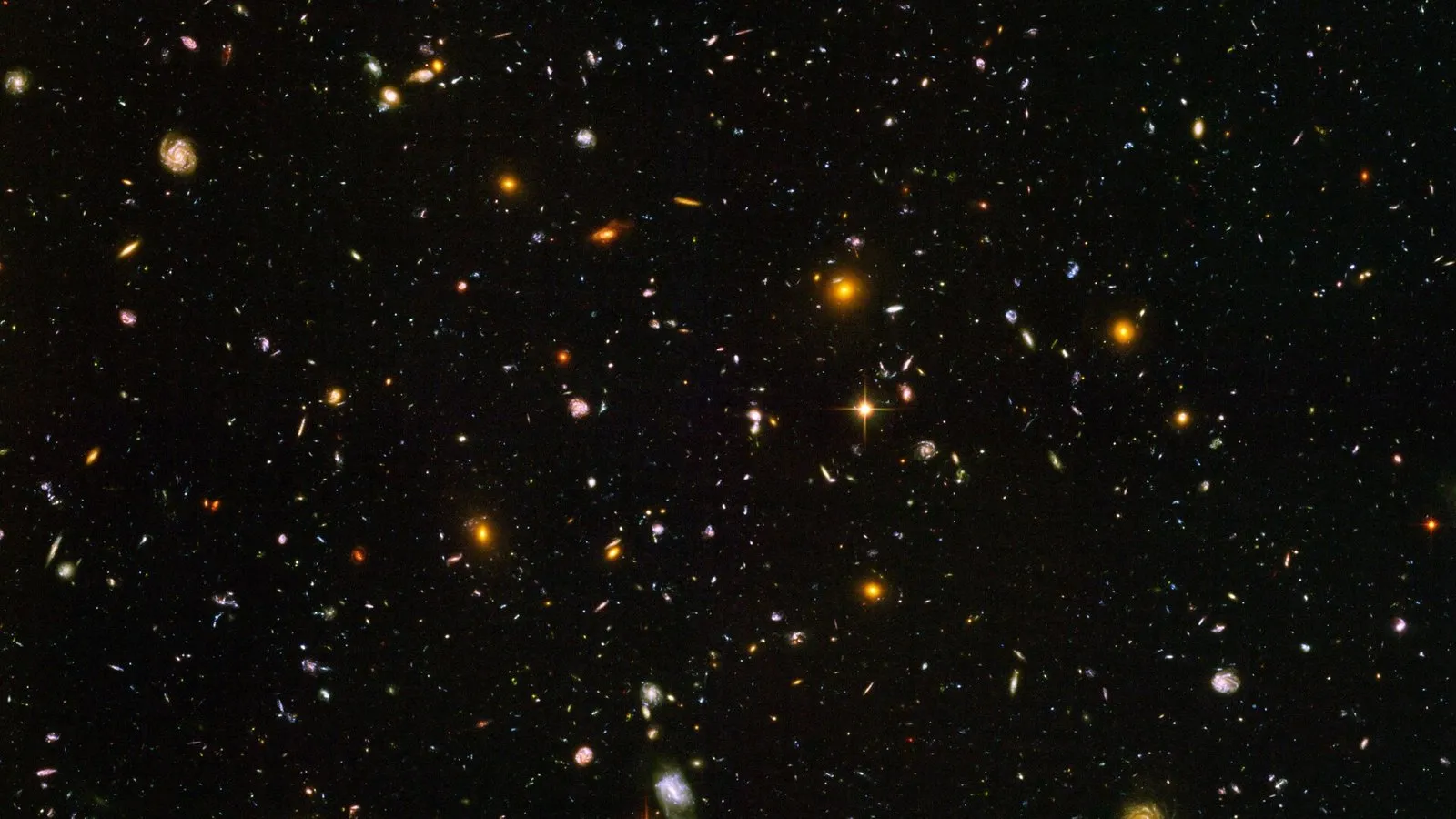
The Milky Way is one of many billions of galaxies that make up the Universe. The diameter of the Milky Way is approximately 100 000 light-years.
2Redshift and the expanding Universe
An increase in the observed wavelength of electromagnetic radiation emitted from receding stars and galaxies.
The light emitted from distant galaxies appears redshifted compared with light emitted on the Earth: the same pattern of spectral lines is shifted towards longer wavelengths. This means the galaxies are moving away from us. More distant galaxies show greater redshift, so they are receding faster.
Redshift in the light from distant galaxies is evidence that the Universe is expanding, and it supports the Big Bang Theory – the idea that the Universe began from a single, extremely hot, dense point and has been expanding ever since.
3Cosmic microwave background radiation (Supplement)
Microwave radiation of a specific frequency is observed at all points in space around us. It is called the cosmic microwave background radiation (CMBR).
The CMBR was produced shortly after the Universe was formed, as very high-energy, short-wavelength radiation. As the Universe expanded, this radiation was stretched (its wavelength increased) into the microwave region of the electromagnetic spectrum. Its existence is further evidence for the Big Bang.
4The Hubble constant and the age of the Universe (Supplement)
- The speed v at which a galaxy is moving away can be found from the change in wavelength of its starlight due to redshift.
- The distance d of a far galaxy can be found using the brightness of a supernova in that galaxy (a dimmer supernova of known type is further away).
The ratio of the speed at which a galaxy is moving away from the Earth to its distance from the Earth.
The current estimate for is per second.
is the time a galaxy would have taken to reach its present distance at its present speed. Because this is the same for all galaxies, everything appears to have started from the same point at the same time – evidence that all the matter in the Universe was once at a single point.
Worked example
Age of the Universe
(Supplement) Use /s to estimate the age of the Universe in years.
- 1
Age = 1 / H₀.
- 2
Convert to years.
years
Answerabout 14 billion years
5Exam focus
Key words: billions of galaxies; 100 000 light-years; redshift; receding; expanding Universe; Big Bang; CMBR; microwaves; supernova brightness; H₀ = v/d; 2.2 × 10⁻¹⁸ /s; age = 1/H₀.
Quick self-check
Answer in your head first, then reveal.
Increase in observed wavelength (1); of light / electromagnetic radiation from receding galaxies (1).
Light from distant galaxies is redshifted, so they are moving away (1); the Universe is expanding (1); so it was once concentrated at a single point (1).
Microwave radiation observed from all directions in space (1); produced shortly after the Universe formed and stretched into microwaves as it expanded (1).
v = H₀d = 2.2 × 10⁻¹⁸ × 4.0 × 10²⁴ (1) = 8.8 × 10⁶ m/s (1).