Detailed · Deep study
1Background radiation
The ionising radiation that is present everywhere, all the time, from natural and man-made sources.
- Radon gas (in the air): a radioactive gas released from rocks such as granite; it collects in buildings – the largest source.
- Rocks and buildings: natural radioactive isotopes in the ground and in building materials.
- Food and drink: contain small amounts of radioactive isotopes such as potassium-40 and carbon-14.
- Cosmic rays: high-energy radiation from space; stronger at high altitude.
Smaller, man-made contributions include medical X-rays and scans, and nuclear power and weapons testing.
2Detecting and measuring radiation
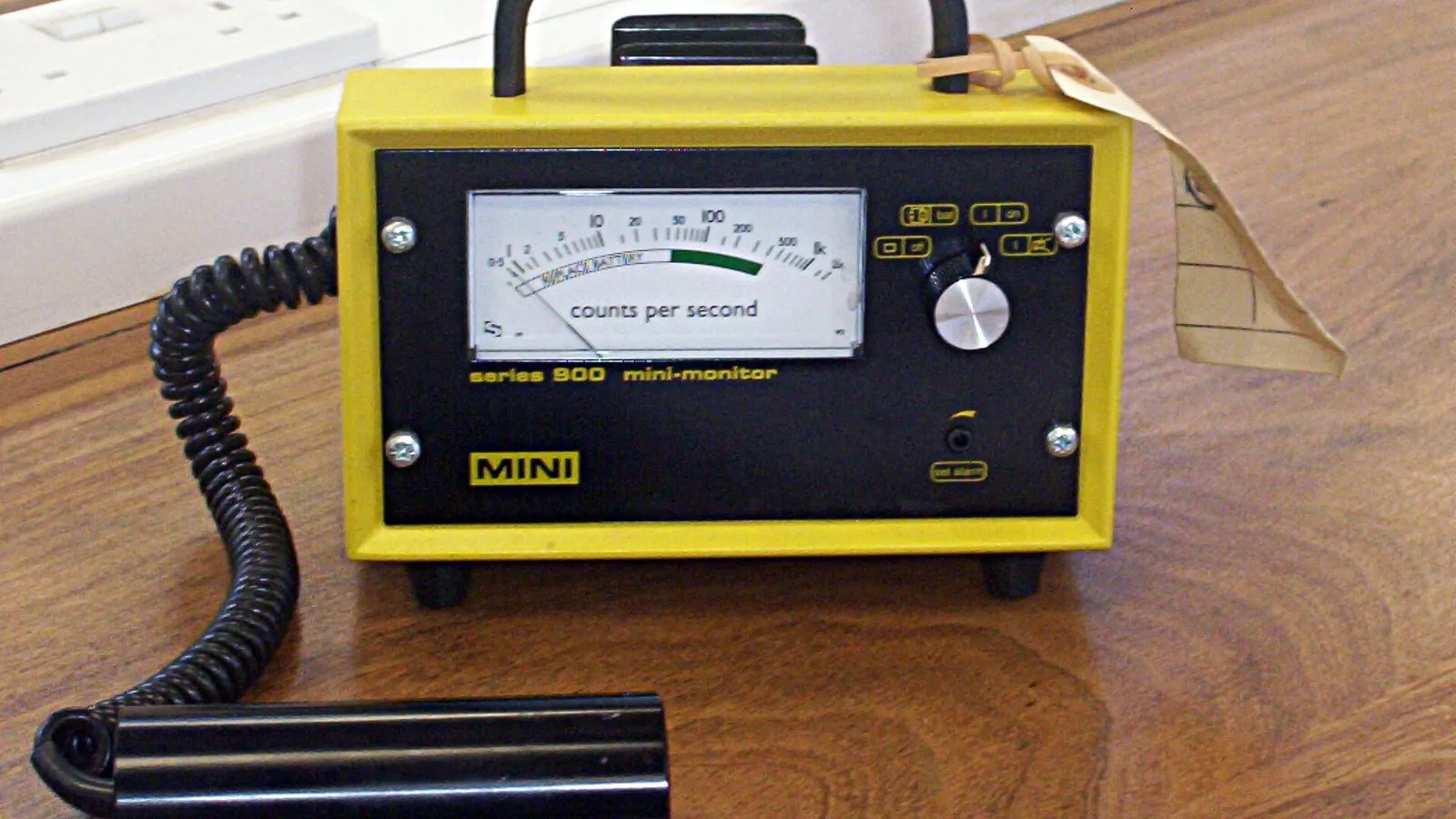
Ionising nuclear radiation is measured using a detector, such as a Geiger–Müller (GM) tube, connected to a counter. Each particle or ray that ionises the gas in the tube produces a pulse, which is counted.
Count rate is measured in counts/s or counts/minute. Because decay is random, count rates fluctuate; take counts over a long time, or repeat and average.
3Corrected count rate (Supplement)
A detector always picks up background radiation as well as radiation from a source. Measure the background count rate with the source removed, then subtract it.
Worked example
Correcting for background
(Supplement) With no source present, a GM tube records 90 counts in 3.0 minutes. With a source, it records 540 counts per minute. Find the corrected count rate.
- 1
Background count rate.
counts/minute
- 2
Subtract.
counts/minute
Answer510 counts/minute
4Exam focus
Key words: background radiation; radon; rocks and buildings; food and drink; cosmic rays; detector and counter; GM tube; count rate; counts/s, counts/minute; corrected count rate.
Quick self-check
Answer in your head first, then reveal.
Radiation that is always present around us (1); from natural / man-made sources (1).
Any two: radon gas; rocks and buildings; food and drink; cosmic rays (2).
240 counts/minute (1).
145 − 25 = 120 counts/minute (1).