Detailed · Deep study
1Construction
A simple transformer has two coils of insulated wire – the primary (input) and the secondary (output) – wound on a closed soft-iron core. It is used to change (transform) an alternating voltage.
- Step-up transformer: more turns on the secondary than the primary; output p.d. greater than input.
- Step-down transformer: fewer turns on the secondary; output p.d. smaller than input.
Worked example
Turns ratio
A transformer steps 230 V down to 11.5 V. The primary has 2000 turns. How many turns are on the secondary?
- 1
N_s = N_p × V_s ÷ V_p.
Answer100 turns
2High-voltage transmission
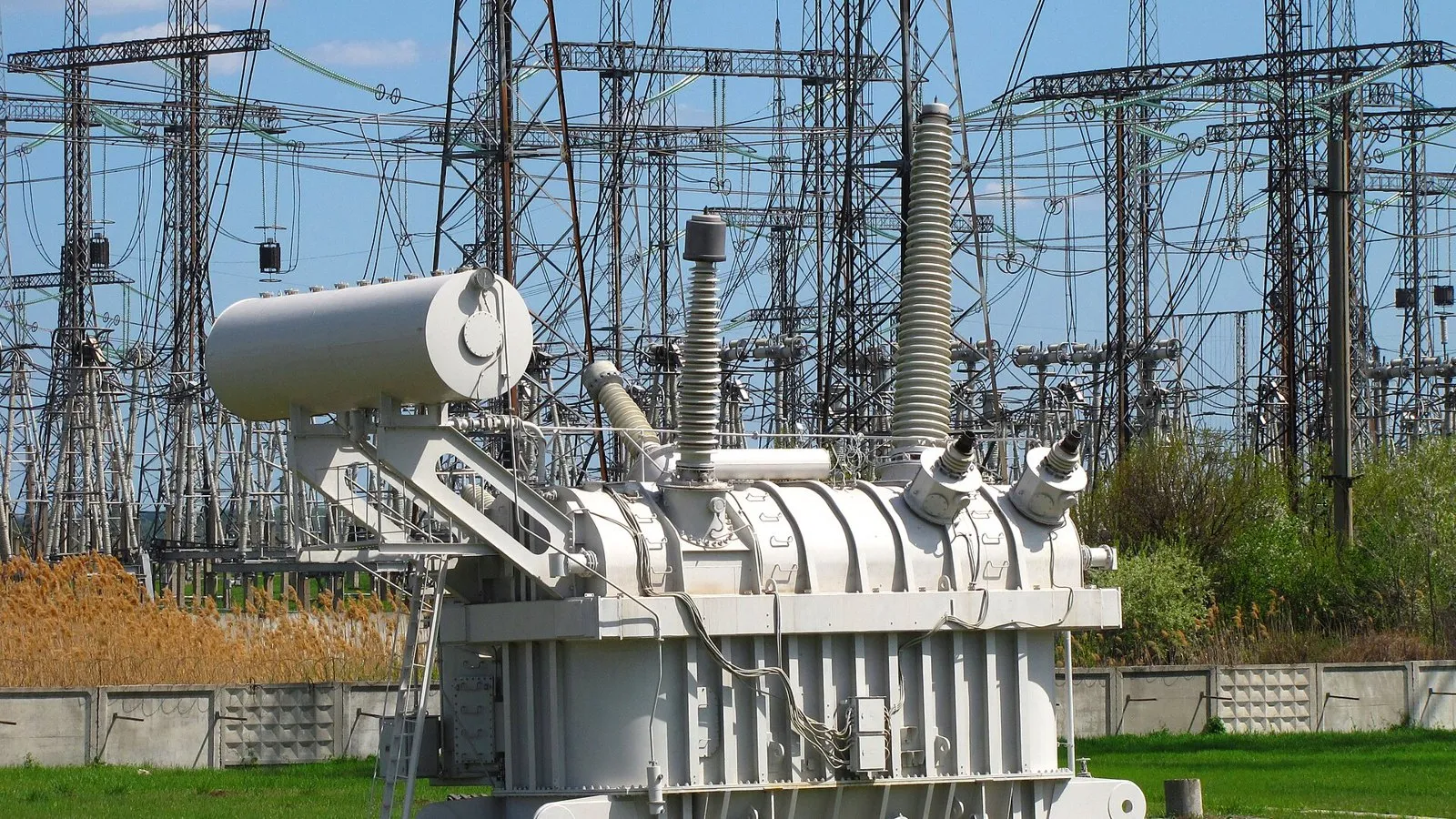
Power stations generate at about 25 kV. Step-up transformers raise this to hundreds of kilovolts for transmission across the country; step-down transformers reduce it to a safe 230 V (or similar) for homes.
- Advantages of high-voltage transmission: for the same power, a higher voltage means a smaller current, so less energy is wasted heating the cables; thinner, cheaper cables can be used and pylons can be further apart.
3How it works and efficiency (Supplement)
- An alternating current in the primary coil produces a changing magnetic field in the soft-iron core.
- The core carries this changing field through the secondary coil.
- The changing field linking the secondary induces an alternating e.m.f. in it (electromagnetic induction).
- A transformer does not work with d.c., because a steady current gives a field that does not change.
Worked example
Why high voltage?
(Supplement) 1.0 MW is sent along cables of total resistance 10 Ω. Compare the power lost at 10 kV and at 100 kV.
- 1
At 10 kV.
;
- 2
At 100 kV.
;
AnswerRaising the voltage 10 times cuts the current 10 times and the power lost 100 times.
4Exam focus
Key words: primary; secondary; soft-iron core; step-up; step-down; Vp/Vs = Np/Ns; high voltage, small current, less energy lost; changing field induces e.m.f.; IpVp = IsVs; P = I²R.
Quick self-check
Answer in your head first, then reveal.
Vs = 12 × 2500 ÷ 500 (1) = 60 V (1).
Smaller current so less energy / power lost in cables (1).
d.c. produces a steady / unchanging field (1); no changing field, so no e.m.f. induced in the secondary (1).
240 × Ip = 12 × 2.0 (1); Ip = 0.10 A (1).