Detailed · Deep study
1Field patterns
- Straight wire: the field lines are concentric circles centred on the wire, in a plane at right angles to it. Right-hand grip rule: grip the wire with your right hand, thumb along the current; your fingers curl in the direction of the field.
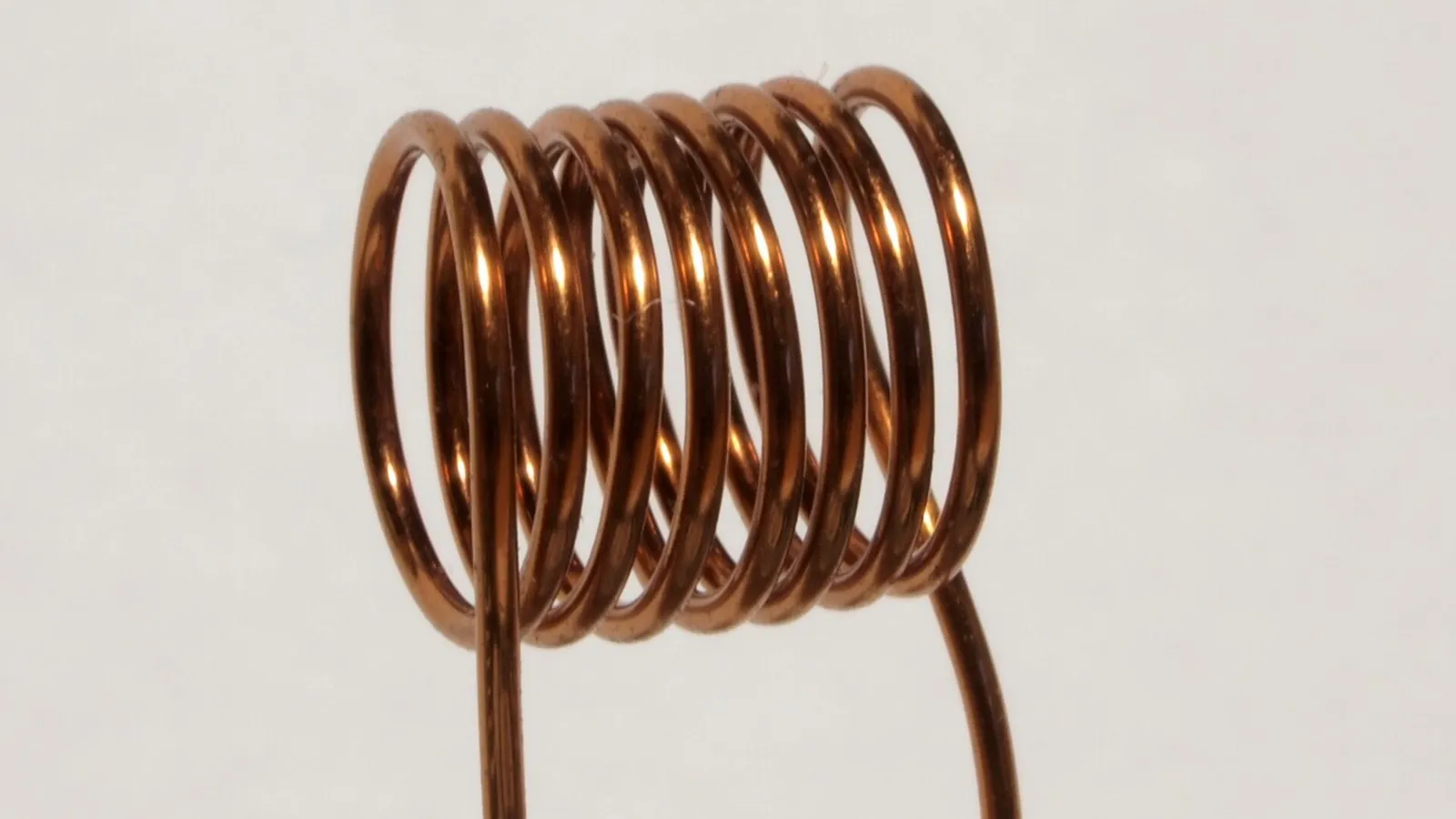
- Solenoid (long coil): the field outside is like that of a bar magnet; inside, the lines are parallel and close together – a strong, uniform field. The end where the current flows anticlockwise (seen from that end) is a N pole.
Practical
Plotting the field of a wire or solenoid
Aim. To find the pattern and direction of the field due to a current.
Method
- Pass the wire vertically through a horizontal card (or place the solenoid through a card).
- Switch on the current, sprinkle iron filings on the card and tap gently to show the pattern.
- Place plotting compasses on the card to show the direction of the field; reverse the current and observe.
Results. Circles round a wire; a bar-magnet pattern for a solenoid. Reversing the current reverses the compass directions.
Safety. Use a low voltage supply and switch off between readings – the wire gets hot.
2Strength of the field (Supplement)
- Straight wire: the field is strongest close to the wire and gets weaker further away (circles spread out).
- Solenoid: the field is strongest inside; it is stronger with more turns, a larger current, or a soft-iron core.
- Increasing the current makes the field stronger; reversing the current reverses the direction of the field.
3Applications: relays and loudspeakers
- Relay: a small current in a coil magnetises a soft-iron core, which attracts an armature and closes (or opens) a second circuit. A low-current circuit can safely switch a high-current one – e.g. a car starter motor, or a computer controlling machinery.
- Loudspeaker: an alternating current in a coil attached to a paper cone sits in the field of a permanent magnet; the changing force makes the coil and cone vibrate, producing sound.
4Exam focus
Key words: concentric circles; right-hand grip rule; solenoid like a bar magnet; iron filings; compass; stronger nearer the wire; larger current; reversed current reverses field; relay; loudspeaker.
Quick self-check
Answer in your head first, then reveal.
Concentric circles (1); centred on the wire / in a plane perpendicular to it (1).
Current in coil magnetises the core (1); armature attracted (1); contacts close in the second circuit (1).
Any two: more turns; larger current; iron core (2).