Detailed · Deep study
1Magnetic poles and forces
- Every magnet has a north pole (N pole) and a south pole (S pole).
- Like poles repel; unlike poles attract. Repulsion is the only sure test that an object is a magnet.
- A magnet attracts unmagnetised magnetic materials (iron, steel, nickel, cobalt) – both poles attract them.
- Non-magnetic materials (copper, aluminium, brass, wood, plastic) are not attracted.
Induced magnetism: when a piece of unmagnetised iron is placed near (or touching) a magnet, it becomes magnetised itself – the end nearest the magnet's N pole becomes an S pole. That is why the iron is attracted, and why a chain of paper clips can hang from a magnet.
| Temporary magnet (soft iron) | Permanent magnet (steel) | |
|---|---|---|
| magnetised | easily | with difficulty |
| keeps magnetism? | loses it quickly when removed from the field | keeps it |
| use | electromagnet cores, relays, transformer cores | compasses, fridge magnets, loudspeakers, motors |
2Magnetic fields
a region in which a magnetic pole experiences a force
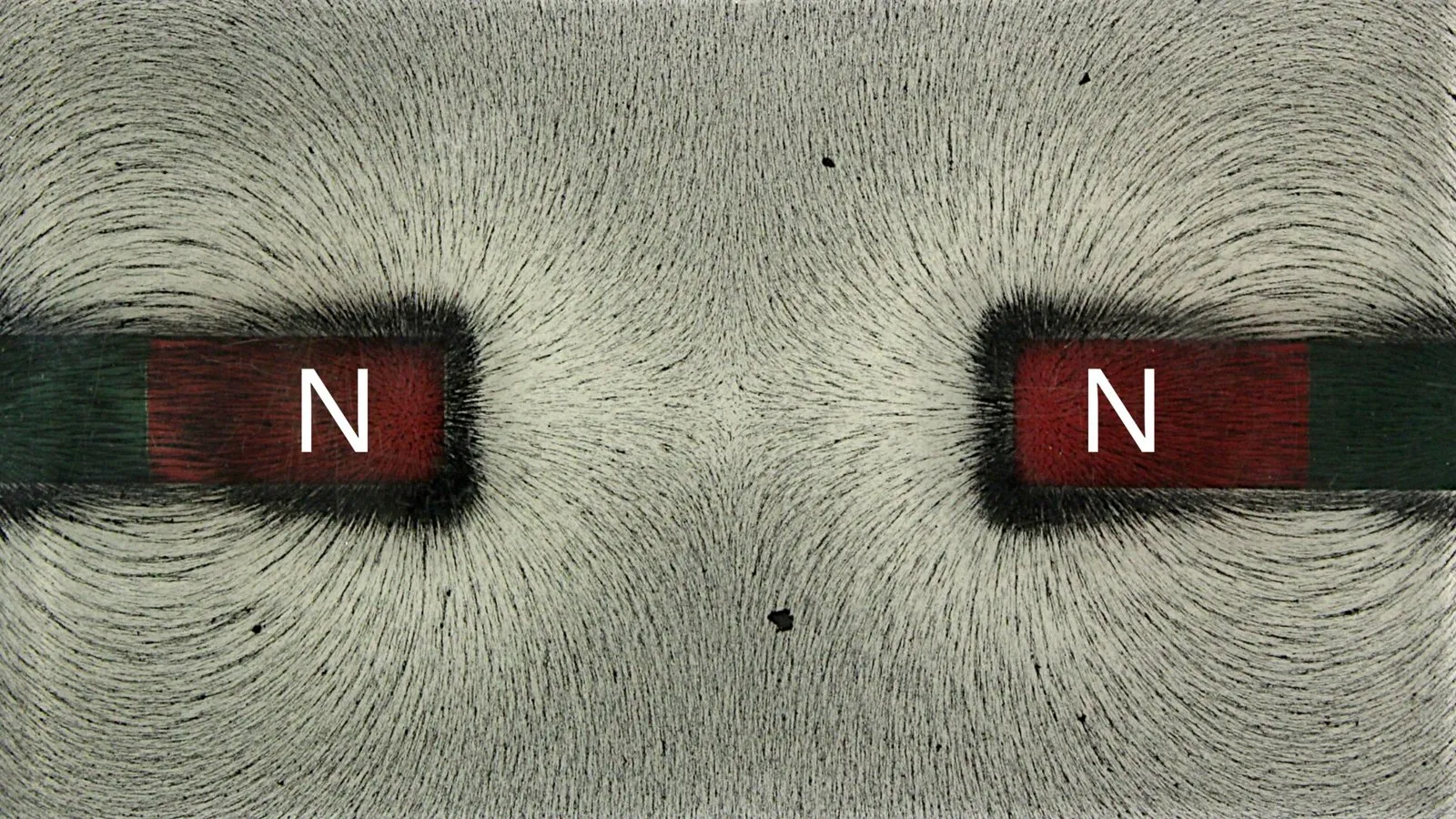
The direction of a magnetic field at a point is the direction of the force on the N pole of a magnet placed there – so field lines point away from N and towards S.
- Iron filings: sprinkle filings on paper over the magnet and tap; they line up along the field lines to show the pattern.
- Plotting compass: place it near the magnet, mark the position of its N end, move the compass to that mark, and repeat; joining the dots gives a field line, and the compass shows its direction.
3Uses of magnets
| Type | Uses |
|---|---|
| permanent magnets | compasses, fridge door seals, loudspeakers, microphones, electric motors and generators |
| electromagnets (soft-iron core; can be switched off) | scrapyard cranes, relays, electric bells, MRI scanners, magnetic door locks |
4Exam focus
Key words: like poles repel; unlike attract; magnetic materials; induced magnetism; soft iron temporary; steel permanent; field – region where a pole experiences a force; direction of force on a N pole; compass; iron filings.
Quick self-check
Answer in your head first, then reveal.
Place compass near magnet and mark where the N end points (1); move compass to the mark and repeat (1); join the dots to give a field line, with arrows N to S (1).
It is magnetised easily and loses its magnetism when the current is switched off (1).
Region in which a magnetic pole experiences a force (1).
Lines are closest together (1).