Detailed · Deep study
1Refraction of light
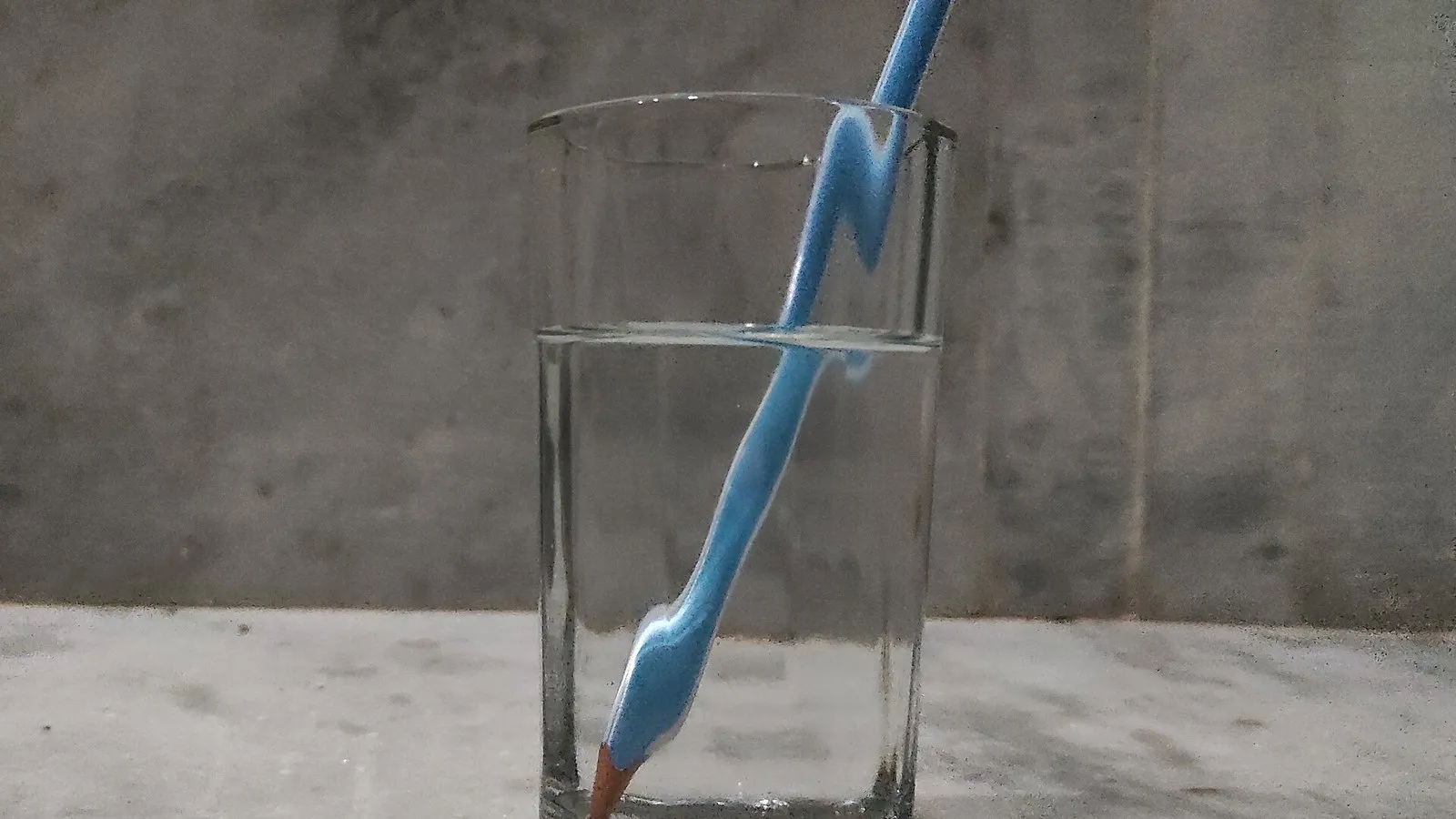
Light travels more slowly in glass or water than in air. When it crosses a boundary at an angle, the change in speed makes it change direction – refraction. The angles are measured from the normal.
- Angle of incidence (i): between the incident ray and the normal.
- Angle of refraction (r): between the refracted ray and the normal.
- Air → glass (slows down): bends towards the normal; glass → air (speeds up): bends away from the normal.
- A ray along the normal (i = 0) does not bend.
Practical
Refraction through a glass block
Aim. To show refraction of light by transparent blocks of different shapes.
Method
- Place a rectangular glass block on paper and draw round it.
- Shine a narrow ray from a ray box at the block at an angle; mark the incident and emerging rays with crosses.
- Remove the block, join the points and draw normals; measure i and r.
- Repeat with a triangular prism and a semicircular block.
Results. The ray bends towards the normal entering the block and away from it leaving; for a rectangular block the emerging ray is parallel to the incident ray.
Safety. The ray box gets hot.
2Critical angle and total internal reflection
the angle of incidence in the denser medium at which the angle of refraction is 90°
- Light inside glass meeting the boundary with air: at small angles most light refracts out, with a weak internal reflection.
- At the critical angle (about 42° for glass) the refracted ray runs along the surface.
- Above the critical angle all the light is reflected back into the glass: total internal reflection.
Examples: prisms in periscopes and binoculars (reflect light through 90° or 180°), diamonds sparkling, cat's-eye road reflectors, and optical fibres.
3Refractive index (Supplement)
the ratio of the speeds of a wave in two different regions
Worked example
Refractive index
A ray enters glass with i = 40° and r = 25°. Find n and the critical angle.
- 1
n = sin i ÷ sin r.
- 2
sin c = 1 ÷ n.
Answern = 1.52; c = 41°
Optical fibres are thin flexible strands of glass. Light entering one end hits the boundary at angles greater than the critical angle, so it is totally internally reflected along the fibre with very little loss. In telecommunications they carry telephone, internet and cable TV signals as pulses of light or infrared at very high data rates; in medicine endoscopes let doctors see inside the body.
4Exam focus
Key words: normal; angle of incidence; angle of refraction; towards / away from the normal; change of speed; critical angle – angle of refraction 90°; total internal reflection; n = sin i / sin r; n = 1/sin c; optical fibres.
Quick self-check
Answer in your head first, then reveal.
Angle of incidence (in the denser medium) (1); for which the angle of refraction is 90° (1).
It slows down (1); bends towards the normal (1).
Light travelling from denser to less dense medium (1); angle of incidence greater than the critical angle (1).
sin c = 1 ÷ 1.33 (1); c = 49° (1).
Total internal reflection (1); angle of incidence always greater than the critical angle (1).