Detailed · Deep study
1The moment of a force
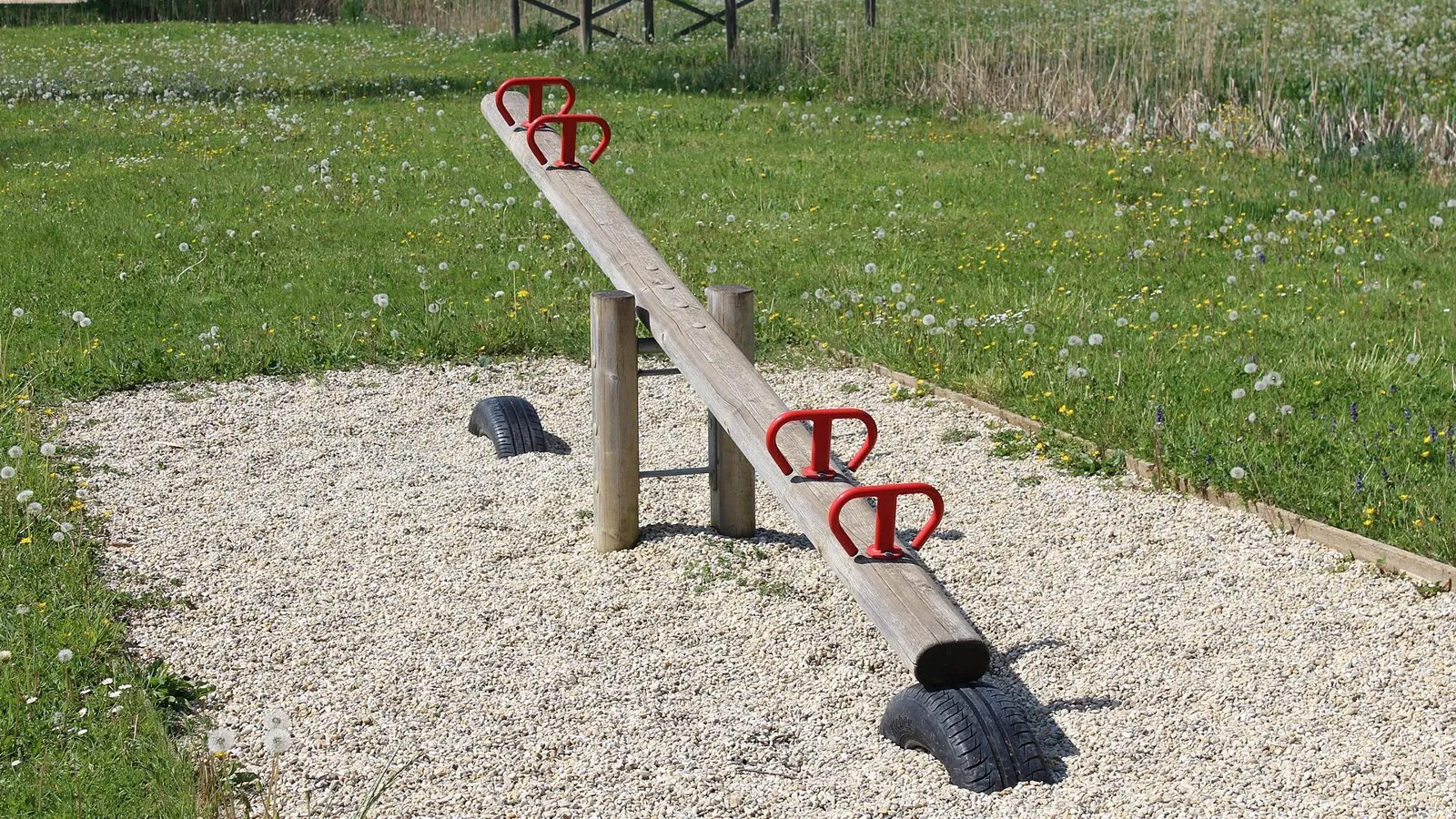
The moment of a force is a measure of its turning effect about a pivot. Everyday examples: pushing a door at the handle (far from the hinges) opens it easily; a long spanner turns a tight nut more easily; a see-saw balances when a heavier child sits nearer the pivot.
The unit is the newton metre (N m). The distance must be measured at right angles to the line of action of the force.
2The principle of moments
When an object is balanced (not turning), the total clockwise moment about a pivot equals the total anticlockwise moment about the same pivot.
Worked example
Balancing a see-saw
A child of weight 300 N sits 2.0 m from the pivot of a see-saw. Where must a child of weight 400 N sit to balance it?
- 1
Anticlockwise moment.
- 2
Clockwise moment must equal it.
Answer1.5 m from the pivot, on the other side
An object is in equilibrium when there is no resultant force and no resultant moment – it stays at rest (or moves at constant velocity without turning).
More than one force each side (Supplement)
Worked example
Several forces
A uniform metre rule is balanced at its centre. A 2.0 N weight hangs 30 cm left of the pivot and a 1.0 N weight 10 cm left. Where must a 4.0 N weight hang on the right?
- 1
Total anticlockwise moment.
- 2
Clockwise moment.
Answer17.5 cm right of the pivot
Practical
Showing there is no resultant moment in equilibrium
Aim. To show that clockwise and anticlockwise moments are equal for a balanced rule.
Method
- Balance a metre rule on a pivot at its centre (so its own weight has no moment).
- Hang different weights at different distances on both sides until the rule balances again.
- Record each force and its distance from the pivot.
- Calculate the total clockwise and total anticlockwise moments.
| independent variable | positions and sizes of weights |
|---|---|
| dependent variable | whether the rule balances |
| controlled variable | pivot at the centre of the rule |
Results. The two totals are equal (within experimental error), so there is no resultant moment.
3Exam focus
Key words: turning effect; force × perpendicular distance from the pivot; N m; principle of moments; clockwise = anticlockwise; equilibrium – no resultant force and no resultant moment.
Quick self-check
Answer in your head first, then reveal.
Force × perpendicular distance from the pivot (1).
Larger (perpendicular) distance (1); gives a larger moment for the same force / less force needed (1).
50 × 0.30 = 15 N m (1).
No resultant force (1); no resultant moment (1).