Detailed · Deep study
1Tests for anions
| Anion | Test | Positive result |
|---|---|---|
| carbonate, CO₃²⁻ | add dilute acid; test the gas with limewater | effervescence; carbon dioxide turns limewater milky |
| chloride, Cl⁻ | acidify with dilute nitric acid, then add aqueous silver nitrate | white precipitate (AgCl) |
| bromide, Br⁻ | as for chloride | cream precipitate (AgBr) |
| iodide, I⁻ | as for chloride | yellow precipitate (AgI) |
| nitrate, NO₃⁻ | add aqueous sodium hydroxide and aluminium foil; warm carefully | ammonia given off – turns damp red litmus paper blue |
| sulfate, SO₄²⁻ | acidify with dilute nitric acid, then add aqueous barium nitrate | white precipitate (BaSO₄) |
| sulfite, SO₃²⁻ | add acidified aqueous potassium manganate(VII) | colour changes from purple to colourless |
2Tests for aqueous cations
Add aqueous sodium hydroxide (or aqueous ammonia) drop by drop, then in excess. Most metal hydroxides are insoluble and form coloured precipitates.
| Cation | Aqueous sodium hydroxide | Aqueous ammonia |
|---|---|---|
| aluminium, Al³⁺ | white ppt, soluble in excess → colourless solution | white ppt, insoluble in excess |
| ammonium, NH₄⁺ | ammonia produced on warming (damp red litmus → blue) | – |
| calcium, Ca²⁺ | white ppt, insoluble in excess | no ppt, or very slight white ppt |
| chromium(III), Cr³⁺ | green ppt, soluble in excess | green ppt, insoluble in excess |
| copper(II), Cu²⁺ | light blue ppt, insoluble in excess | light blue ppt, soluble in excess → dark blue solution |
| iron(II), Fe²⁺ | green ppt, insoluble in excess; turns brown near the surface on standing | green ppt, insoluble in excess |
| iron(III), Fe³⁺ | red-brown ppt, insoluble in excess | red-brown ppt, insoluble in excess |
| zinc, Zn²⁺ | white ppt, soluble in excess → colourless solution | white ppt, soluble in excess → colourless solution |
3Tests for gases
| Gas | Test | Positive result |
|---|---|---|
| ammonia, NH₃ | damp red litmus paper | turns blue |
| carbon dioxide, CO₂ | bubble through limewater | limewater turns milky |
| chlorine, Cl₂ | damp litmus paper | bleached (turns white) |
| hydrogen, H₂ | lighted splint | "squeaky pop" |
| oxygen, O₂ | glowing splint | relights |
| sulfur dioxide, SO₂ | acidified aqueous potassium manganate(VII) | purple → colourless |
4Flame tests
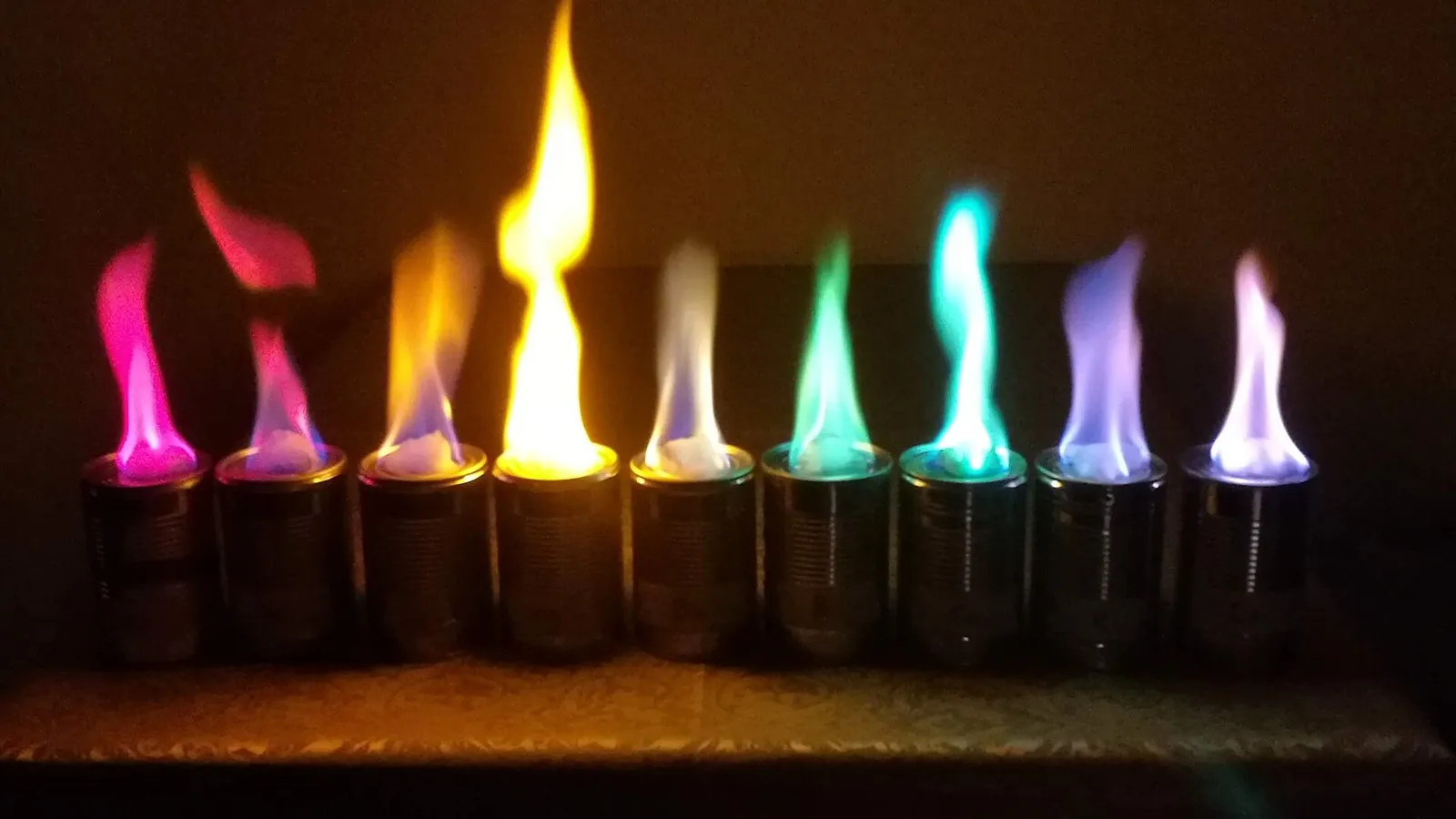
Dip a clean nichrome or platinum wire (cleaned in concentrated hydrochloric acid) into the solid sample and hold it in a blue (roaring) Bunsen flame. The colour of the flame identifies the metal ion.
| Cation | Flame colour |
|---|---|
| lithium, Li⁺ | red |
| sodium, Na⁺ | yellow |
| potassium, K⁺ | lilac |
| calcium, Ca²⁺ | orange-red |
| barium, Ba²⁺ | light green |
| copper(II), Cu²⁺ | blue-green |
5Exam focus
Key words: acidify with dilute nitric acid; silver nitrate – white / cream / yellow; barium nitrate – white; aluminium foil and sodium hydroxide – ammonia; precipitate; soluble / insoluble in excess; damp red litmus; limewater milky; bleached; squeaky pop; relights; purple to colourless; flame colours.
Quick self-check
Answer in your head first, then reveal.
Acidify with dilute nitric acid, add aqueous silver nitrate (1); yellow precipitate (1).
Copper(II), Cu²⁺ (1).
Add aqueous sodium hydroxide (1); Fe²⁺ gives green precipitate, Fe³⁺ red-brown precipitate (1).
Lighted splint (1); squeaky pop (1).
Potassium sulfate (2).
It contains chloride ions (1); which would give a white precipitate anyway (1).