Detailed · Deep study
1Properties of solids, liquids and gases
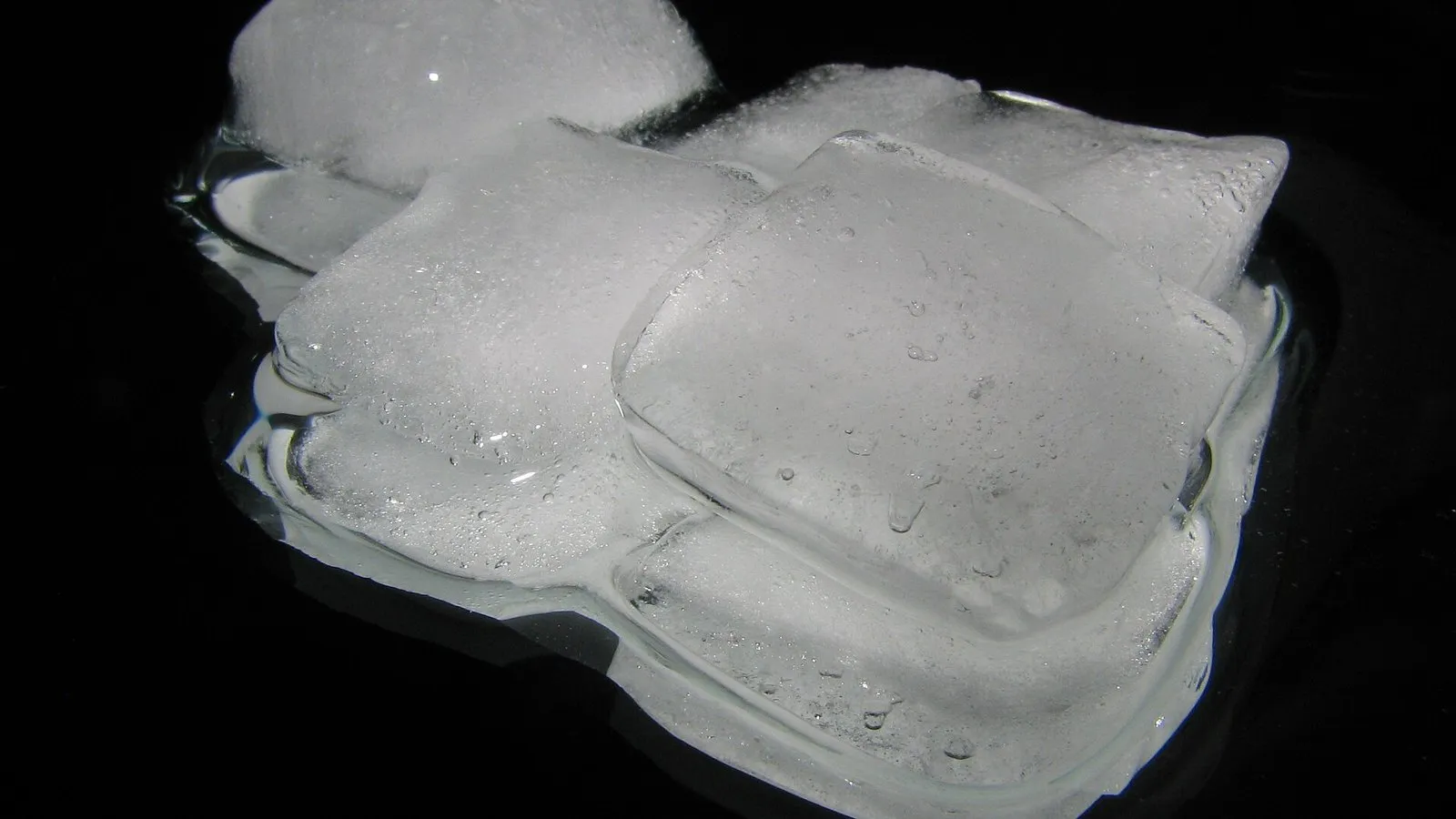
Matter is anything that has mass and takes up space. Almost every substance you meet is in one of three states of matter: solid, liquid or gas. Water is the familiar example – ice, liquid water and steam are the same substance in three different states.
Distinguishing properties
| Property | Solid | Liquid | Gas |
|---|---|---|---|
| Shape | fixed shape | no fixed shape – takes the shape of its container | no fixed shape – spreads out to fill the whole container |
| Volume | fixed volume | fixed volume | no fixed volume |
| Can it be compressed? | no | only very slightly | yes, easily |
| Can it flow? | no | yes | yes |
| Density (same substance) | usually highest | usually slightly lower than the solid | very low |
Expansion and contraction
Solids and liquids get slightly bigger when heated (expansion) and slightly smaller when cooled (contraction). Gases change volume much more. Gaps are left between sections of railway track and bridges for this reason, and liquid thermometers work because the liquid expands as it warms.
2Particles in the three states
The kinetic particle theory explains the properties of the states using a simple model:
- All matter is made of tiny particles (atoms, molecules or ions), far too small to see.
- The particles are always moving. The higher the temperature, the more kinetic energy they have and the faster they move on average.
- There are forces of attraction between the particles. The closer the particles, the more these forces matter.
Separation, arrangement and motion
| Solid | Liquid | Gas | |
|---|---|---|---|
| Separation | very close together, touching | close together, mostly touching | far apart compared with their size |
| Arrangement | regular pattern (a lattice) | random, no pattern | random, no pattern |
| Motion | vibrate about fixed positions; cannot move from place to place | move around and slide past one another | move quickly and randomly in all directions, colliding with each other and the container walls |
| Forces between particles | strong | weaker than in the solid | very weak (almost none) |
Linking particles to properties
- A solid has a fixed shape because its particles are held in fixed positions by strong forces; they can only vibrate.
- A liquid flows and takes the shape of its container because its particles can slide past each other, but it keeps a fixed volume because the particles stay close together.
- A gas fills any container because its particles move freely in all directions, and it is easy to compress because there is a lot of space between the particles.
3Changes of state
| Change | From → to | Energy | Key point |
|---|---|---|---|
| Melting | solid → liquid | taken in | happens at the melting point |
| Boiling | liquid → gas | taken in | happens at the boiling point; bubbles of gas form throughout the liquid |
| Evaporating | liquid → gas | taken in | happens at the surface, at temperatures below the boiling point |
| Condensing | gas → liquid | given out | e.g. steam forming droplets on a cold window |
| Freezing | liquid → solid | given out | happens at the same temperature as the melting point |
Melting and boiling points
A pure substance melts and boils at fixed temperatures. The melting point is the temperature at which a solid turns into a liquid; the boiling point is the temperature at which a liquid boils. Freezing happens at the same temperature as melting.
| Substance | Melting point / °C | Boiling point / °C | State at 25 °C |
|---|---|---|---|
| Oxygen | −218 | −183 | gas |
| Ethanol | −114 | 78 | liquid |
| Water | 0 | 100 | liquid |
| Mercury | −39 | 357 | liquid |
| Sodium chloride | 801 | 1413 | solid |
Boiling compared with evaporating
| Boiling | Evaporating | |
|---|---|---|
| Temperature | only at the boiling point | at any temperature below the boiling point |
| Where it happens | throughout the liquid (bubbles form) | only at the surface |
| Speed | fast | slow |
Evaporation is faster when the liquid is warmer, has a larger surface area, or when air moves over it (wind) – which is why washing dries best on a warm, windy day.
4Explaining changes of state (Supplement)
What happens to the particles
- Melting: on heating, the particles in the solid gain energy and vibrate more. At the melting point they have enough energy to overcome some of the forces holding them in fixed positions, so they can move past each other.
- Boiling: the particles in the liquid gain energy and move faster. At the boiling point they have enough energy to overcome the forces of attraction between them completely and escape as a gas.
- Evaporating: at any temperature, some particles at the surface of a liquid have enough energy to escape. Because the fastest particles leave, the liquid left behind cools down.
- Condensing and freezing: on cooling, the particles lose energy and move more slowly. The forces of attraction pull them closer together (gas → liquid) and then into fixed positions (liquid → solid). Energy is given out.
Heating curves
A heating curve is a graph of temperature against time for a substance heated at a steady rate. Because energy is supplied at a steady rate, the time axis also shows how much energy has been taken in.
| Part of the curve | State(s) present | What the energy does |
|---|---|---|
| Sloping (rising) | one state only | increases the kinetic energy of the particles, so the temperature rises |
| Flat at 0 °C | solid and liquid | overcomes the forces holding particles in the lattice – the ice melts; temperature stays constant |
| Flat at 100 °C | liquid and gas | overcomes the forces between particles in the liquid – the water boils; temperature stays constant |
Cooling curves
A cooling curve shows the temperature as a substance cools. The flat section is where it changes state: as the particles come together and the forces of attraction form, energy is given out, and this balances the energy lost to the surroundings, so the temperature stays constant.
The temperature of the flat section is the freezing point, which is the same as the melting point. A pure substance gives a sharp, level section; an impure one freezes gradually over a range of temperatures.
5Temperature, pressure and the volume of a gas
Describing the effects
| Change (the other condition kept the same) | Effect on the volume of the gas |
|---|---|
| Temperature increases (pressure constant) | volume increases – the gas expands |
| Temperature decreases (pressure constant) | volume decreases – the gas contracts |
| Pressure increases (temperature constant) | volume decreases – the gas is compressed |
| Pressure decreases (temperature constant) | volume increases |
Everyday examples: a balloon shrinks in a freezer and swells in the sun; the air in a bicycle pump takes up less space as you push the handle in.
Explaining the effects (Supplement)
Gas pressure is caused by the particles colliding with the walls of their container. Each collision pushes on the wall.
- Higher temperature: the particles gain kinetic energy and move faster. They hit the walls more often and with more force. If the container can expand (for example a balloon or a syringe with a free piston), the gas takes up a larger volume.
- Higher pressure: a greater force pushes the particles closer together. There is a lot of space between gas particles, so the same particles fit into a smaller volume.
- Lower temperature or lower pressure: the reverse – slower particles hit the walls less often and less hard, or the particles are allowed to spread further apart.
6Exam focus
Key words that earn marks: fixed shape / fixed volume; compressible; particles close together / far apart; regular / random arrangement; vibrate about fixed positions; slide past each other; move randomly; forces of attraction between particles; kinetic energy; melting point / boiling point; temperature stays constant during a change of state; collisions with the container walls.
Quick self-check
Answer in your head first, then reveal.
Close together / touching but randomly arranged (1); move around / slide past each other (1).
Gas particles are far apart / have large spaces between them (1); liquid particles are close together / touching, so there is little space to push them into (1).
(a) solid (1) (b) liquid (1) (c) gas (1).
Evaporation happens at any temperature below the boiling point, boiling only at the boiling point (1); evaporation happens only at the surface, boiling throughout the liquid (1).
The ice is melting / changing state (1); the energy taken in is used to overcome the forces of attraction between the particles (1); rather than to increase their kinetic energy, so the temperature does not rise until all the ice has melted (1).
The particles gain (kinetic) energy / move faster (1); they hit the piston / walls more often and with more force (1); this pushes the piston out, so the gas occupies a larger volume (1).