Detailed · Deep study
1What transpiration is
the loss of water vapour from leaves
- Water arrives in the leaf in the xylem and passes into the mesophyll cells.
- Water evaporates from the surfaces of the mesophyll cells into the air spaces.
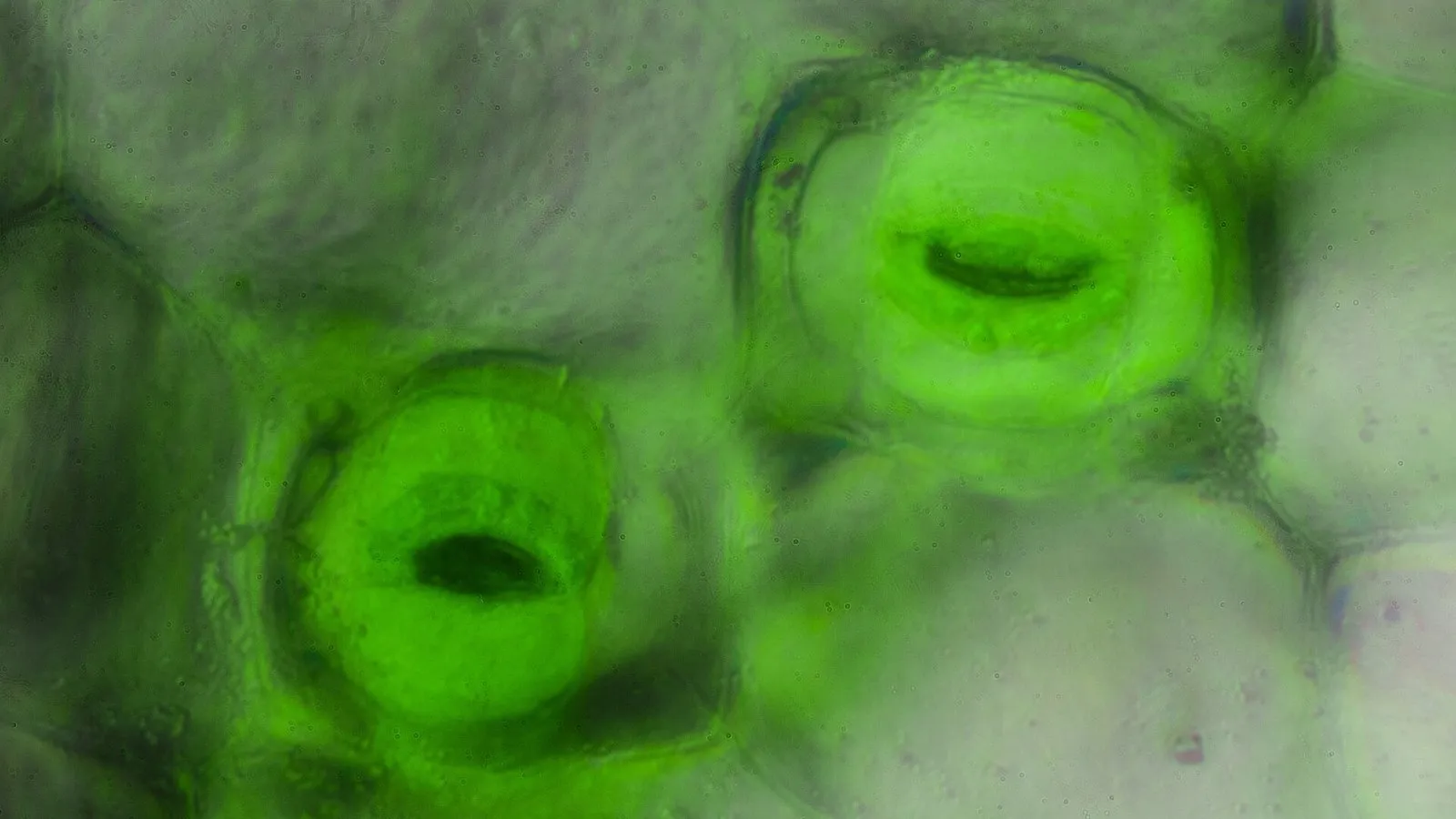
- The water vapour diffuses out of the leaf through the stomata.
2Investigating transpiration
Practical
Effect of temperature and wind speed on transpiration rate
Aim. To investigate how temperature and wind speed affect the rate of transpiration.
Method
- Cut a leafy shoot under water (to stop air entering the xylem) and fit it into a potometer, also under water. Seal the joints.
- Let in one air bubble and leave the apparatus for 5 minutes to settle.
- Measure the distance the bubble moves in a fixed time, e.g. 5 minutes. Repeat and find the mean.
- Change one factor: place a fan at different distances (wind speed), or place the apparatus in rooms or near a heater at different temperatures.
- Reset the bubble using the reservoir between readings.
| independent variable | Temperature or wind speed |
|---|---|
| dependent variable | Distance moved by the bubble per minute |
| controlled variable | Same shoot, light intensity, humidity, time of reading |
Results. The bubble moves faster at higher temperatures and higher wind speeds, showing a faster rate of water uptake and transpiration.
Safety. Take care with glassware and when cutting the shoot. Keep electrical fans and heaters away from water.
3Explaining transpiration (Supplement)
| Feature | Effect on water vapour loss |
|---|---|
| Interconnecting air spaces between mesophyll cells | Give a large internal surface area from which water can evaporate, so much water vapour is produced |
| Number of stomata | More stomata → more pores for water vapour to diffuse out → more loss |
| Size of stomata | Wider-open stomata → faster loss; stomata close in the dark or when the plant is short of water |
4The transpiration pull (Supplement)
As water evaporates from the leaves, it is replaced by water drawn from the xylem in the leaf veins. This creates a transpiration pull that draws up a column of water molecules in the xylem, all the way from the roots. The column does not break because the water molecules are held together by forces of attraction between water molecules.
5Factors affecting the rate, and wilting (Supplement)
| Factor | Effect | Explanation |
|---|---|---|
| Temperature | Higher → faster | Water molecules have more kinetic energy, so more water evaporates and water vapour diffuses faster |
| Wind speed | Higher → faster | Wind removes water vapour from around the leaf, keeping a steep concentration gradient between the air spaces and the outside air |
| Humidity | Higher → slower | Moist air already contains more water vapour, so the concentration gradient is smaller and diffusion is slower |
Wilting occurs when a plant loses water by transpiration faster than it takes it up from the soil, for example on a hot, dry, windy day or when the soil is dry. Its cells lose water, become flaccid and lose turgor pressure, so they no longer press against each other and support the plant: stems and leaves droop. Wilting can help the plant, because drooping leaves are less exposed and stomata close, reducing further water loss.
See Topic 3 · Movement into and out of cellsTurgid and flaccid cells are covered in 3.2 Osmosis.6Exam focus
Practice questions
Quick self-check
Answer in your head first, then reveal.
Loss of water vapour from leaves.
Water evaporates from the surfaces of mesophyll cells; into the air spaces; water vapour diffuses out through the stomata.
The rate increases.
Water lost by transpiration creates a transpiration pull; this draws up a column of water molecules; held together by forces of attraction between water molecules.
The air contains more water vapour; so the concentration gradient between the leaf and the air is smaller and diffusion is slower.
Water is lost by transpiration faster than it is taken up; cells lose water and become flaccid; they lose turgor pressure and no longer support the plant.