Detailed · Deep study
1Absorption in the small intestine
Absorption is the movement of nutrients from the intestines into the blood. After chemical digestion, the small soluble molecules (glucose, amino acids, fatty acids and glycerol), with vitamins, mineral ions and water, are absorbed through the wall of the small intestine, mainly the ileum.
| Region | What is absorbed |
|---|---|
| Small intestine | Nutrients (digested food, vitamins, mineral ions) and most of the water |
| Colon | Some water, which turns the undigested remains into semi-solid faeces |
2Villi and microvilli (Supplement)
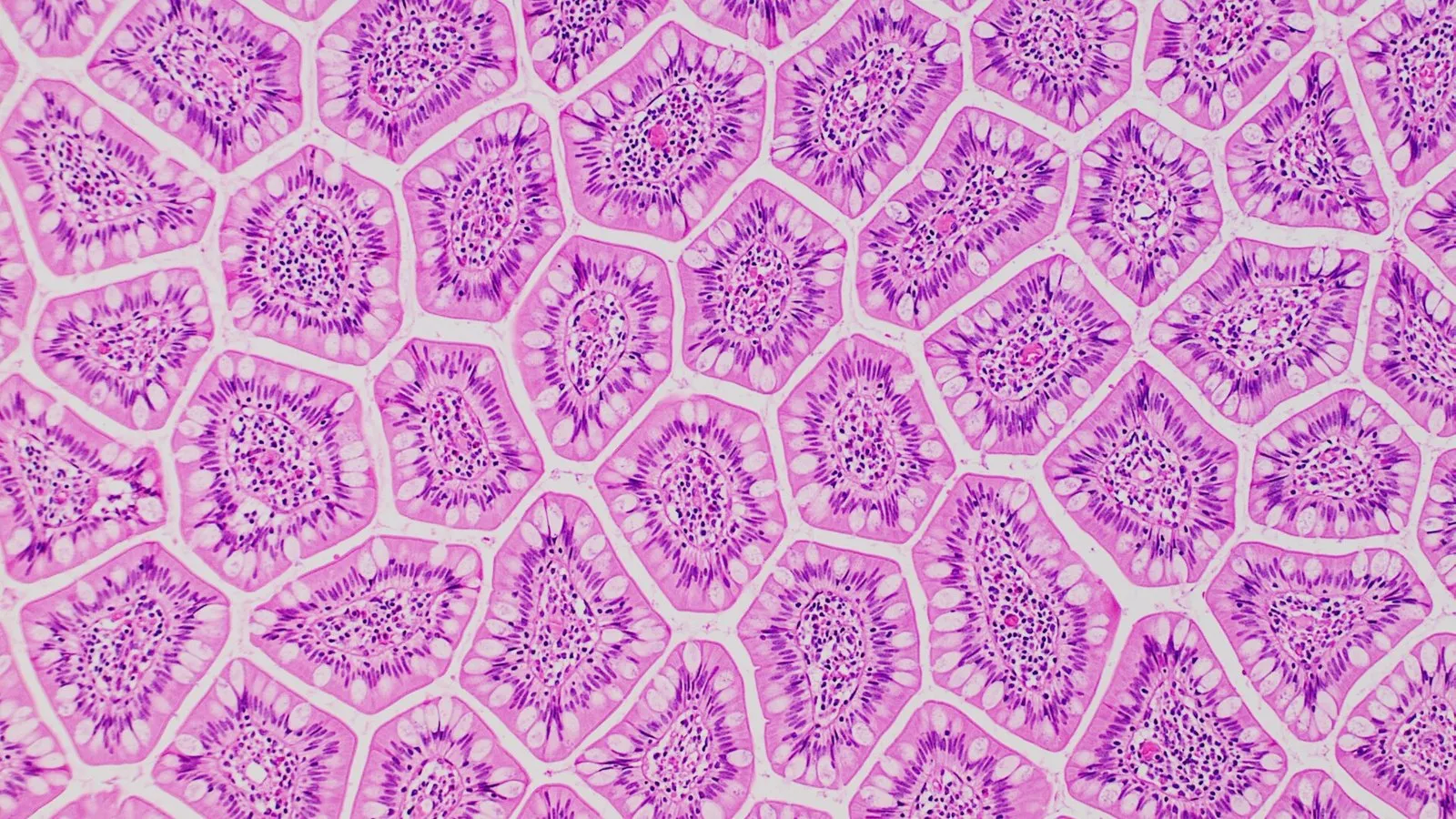
The inner wall of the small intestine is covered with millions of tiny finger-like projections called villi (singular: villus). The epithelial cells covering each villus have even smaller projections on their surface called microvilli. Together they greatly increase the internal surface area of the small intestine, so nutrients are absorbed much faster.
3Structure of a villus (Supplement)
| Feature | How it helps absorption |
|---|---|
| Finger-like shape and microvilli | Large surface area |
| Epithelium one cell thick | Short distance for nutrients to diffuse into the blood |
| Network of blood capillaries | Absorb glucose, amino acids, water, vitamins and mineral ions and carry them away in the blood. This keeps a steep concentration gradient |
| Lacteal (central lymph vessel) | Absorbs fatty acids and glycerol, which are carried away in the lymph and later enter the blood |
| Epithelial cells with many mitochondria | Release energy for active transport of some nutrients, e.g. glucose |
4Exam focus
Practice questions
Quick self-check
Answer in your head first, then reveal.
The small intestine.
Most in the small intestine; some in the colon.
They increase the internal surface area of the small intestine; so absorption is faster / more nutrients absorbed.
Finger-like projection; epithelium one cell thick; with microvilli; network of blood capillaries; central lacteal.
Capillaries absorb glucose and amino acids (and water, ions) into the blood; lacteals absorb fatty acids and glycerol.