Detailed · Deep study
1The breathing system
| Part | Description |
|---|---|
| Larynx | The voice box at the top of the trachea |
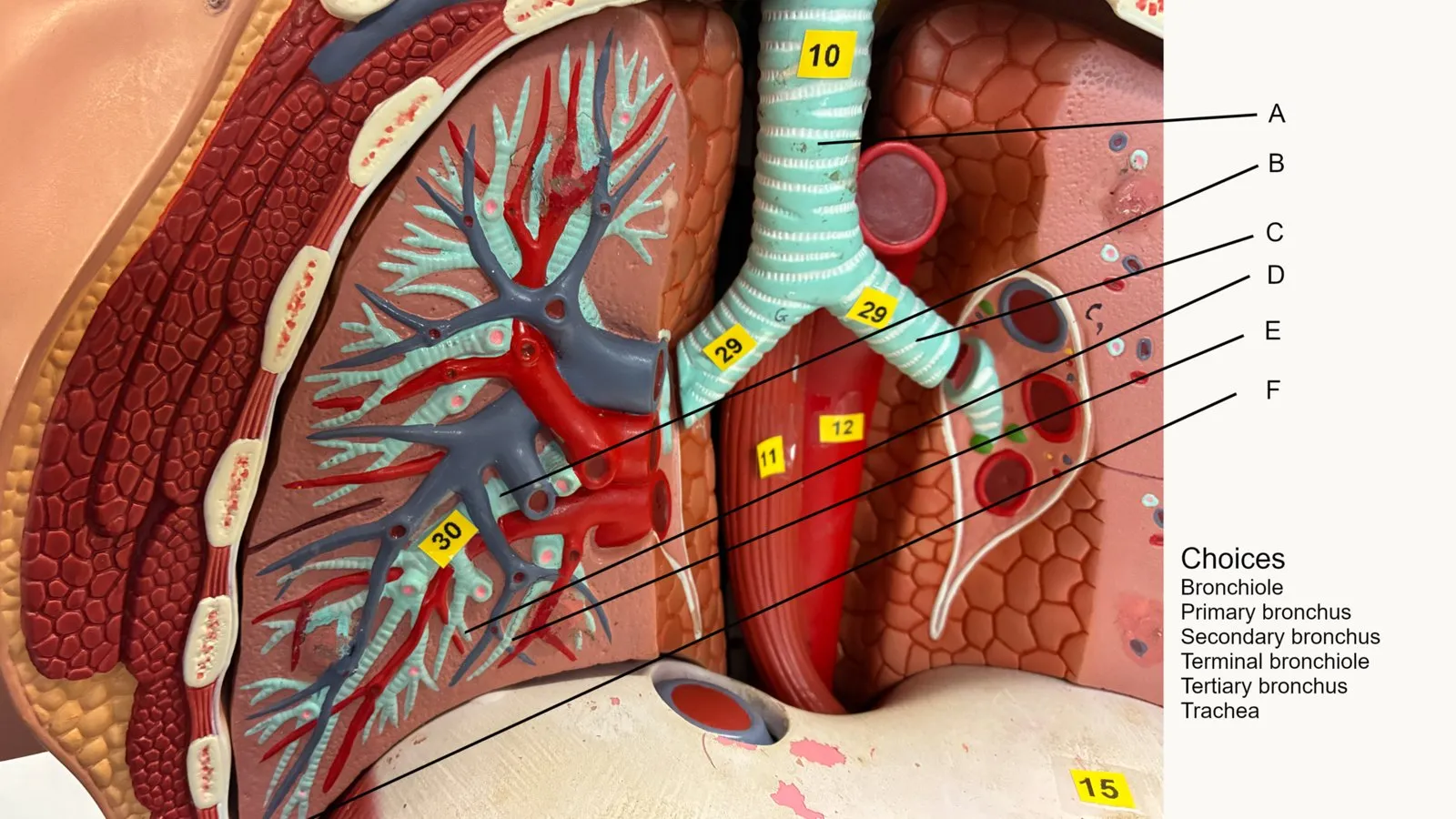
| Trachea | The windpipe, held open by C-shaped rings of cartilage |
| Bronchi | Two branches of the trachea, one to each lung (singular: bronchus) |
| Bronchioles | Smaller and smaller branches inside the lungs |
| Alveoli | Tiny air sacs at the ends of the bronchioles, where gas exchange happens |
| Capillaries | Surround each alveolus, bringing blood close to the air |
| Lungs | Spongy organs made of bronchioles, alveoli and blood vessels |
| Ribs | Bones that protect the lungs and move during breathing |
| Intercostal muscles | Muscles between the ribs |
| Diaphragm | A dome-shaped sheet of muscle below the lungs |
2Gas exchange surfaces
| Feature | How it is achieved in the lungs | Why it speeds up gas exchange |
|---|---|---|
| Large surface area | Millions of alveoli | More oxygen and carbon dioxide can diffuse at the same time |
| Thin surface | Alveolus and capillary walls are each one cell thick | Short diffusion distance |
| Good blood supply | Dense network of capillaries around each alveolus | Blood carries oxygen away and brings carbon dioxide, keeping a steep concentration gradient |
| Good ventilation with air | Breathing replaces the air in the alveoli | Keeps oxygen concentration high and carbon dioxide low in the alveoli |
The alveoli also have a moist lining: oxygen dissolves in this moisture before diffusing into the blood.
See Topic 3 · Movement into and out of cellsDiffusion and concentration gradients are covered in 3.1 Diffusion.3Ventilation of the lungs (Supplement)
| Breathing in (inhaling) | Breathing out (exhaling) | |
|---|---|---|
| External intercostal muscles | Contract | Relax |
| Internal intercostal muscles | Relax | Contract (in forced breathing out) |
| Ribs | Move up and out | Move down and in |
| Diaphragm | Contracts and flattens | Relaxes and domes upwards |
| Volume of thorax | Increases | Decreases |
| Pressure in thorax | Decreases below atmospheric pressure | Increases above atmospheric pressure |
| Air movement | Into the lungs | Out of the lungs |
4Inspired and expired air
| Component | Inspired air | Expired air | Reason for the difference (Supplement) |
|---|---|---|---|
| Oxygen | 21% | 16% | Oxygen diffuses into the blood in the alveoli and is used in respiration |
| Carbon dioxide | 0.04% | 4% | Carbon dioxide is produced in respiration and diffuses from the blood into the alveoli |
| Water vapour | Variable | Saturated | Water evaporates from the moist lining of the alveoli into the air |
Practical
Comparing carbon dioxide in inspired and expired air
Aim. To show that expired air contains more carbon dioxide than inspired air.
Method
- Put equal volumes of limewater into two boiling tubes, A and B, set up with glass tubes and a mouthpiece as in the diagram.
- Breathe in and out gently through the mouthpiece several times. Air breathed in is drawn through tube A; air breathed out is blown through tube B.
- Observe how long it takes for the limewater in each tube to turn milky.
| independent variable | Type of air (inspired or expired) |
|---|---|
| dependent variable | Time for limewater to turn milky |
| controlled variable | Volume and concentration of limewater, number and depth of breaths |
Results. The limewater in B (expired air) turns milky (cloudy) much sooner than the limewater in A (inspired air), so expired air contains more carbon dioxide.
Safety. Breathe gently and do not suck so hard that limewater enters your mouth; limewater is an irritant. Use a clean mouthpiece each time.
5Physical activity and breathing
Practical
Effect of physical activity on rate and depth of breathing
Aim. To investigate how physical activity affects the rate and depth of breathing.
Method
- Sit quietly and count the number of breaths in one minute (breathing rate). Repeat and find a mean.
- Measure depth of breathing, e.g. with a spirometer, or by measuring the change in chest circumference with a tape measure.
- Do a set activity, such as step-ups for 2 minutes.
- Immediately measure the breathing rate and depth again, then every minute until they return to resting values.
| independent variable | Level or duration of physical activity |
|---|---|
| dependent variable | Breathing rate (breaths per minute) and depth |
| controlled variable | Same person, same activity, same method of measurement |
Results. Both the rate and the depth of breathing increase during and just after exercise, then return gradually to resting levels.
Safety. Do not take part if you have a condition such as asthma that makes exercise unsafe. Stop if you feel unwell.
6Protecting the breathing system (Supplement)
| Cell or substance | Role |
|---|---|
| Goblet cells | Make and release mucus |
| Mucus | Sticky; traps pathogens and particles such as dust in the air breathed in |
| Ciliated cells | Have tiny hairs, cilia, that beat to sweep the mucus up and away from the lungs to the throat, where it is swallowed and pathogens are killed by stomach acid |
7Exam focus
Practice questions
Quick self-check
Answer in your head first, then reveal.
Large surface area; thin surface; good blood supply; good ventilation with air.
Less oxygen; more carbon dioxide; more water vapour.
Breathing rate increases; depth of breathing increases.
External intercostal muscles contract, moving ribs up and out; diaphragm contracts and flattens; volume of the thorax increases; pressure decreases (below atmospheric) so air moves in.
Increased carbon dioxide concentration in the blood (from faster respiration); detected by the brain; which increases the rate and depth of breathing.
Goblet cells produce mucus; mucus traps pathogens and particles; cilia sweep the mucus away from the lungs / up to the throat.