Detailed · Deep study
1Diffusion
the net movement of particles from a region of their higher concentration to a region of their lower concentration (i.e. down a concentration gradient), as a result of their random movement
Particles in liquids and gases are always moving about at random, colliding and changing direction. Where there are many particles, more of them move away into areas with fewer particles than move back. The overall, or net, effect is that particles spread from where they are concentrated to where they are less concentrated.
the difference in concentration of a substance between two regions; diffusion happens down the gradient, from high to low
Everyday examples
- The smell of food cooking spreads through a house.
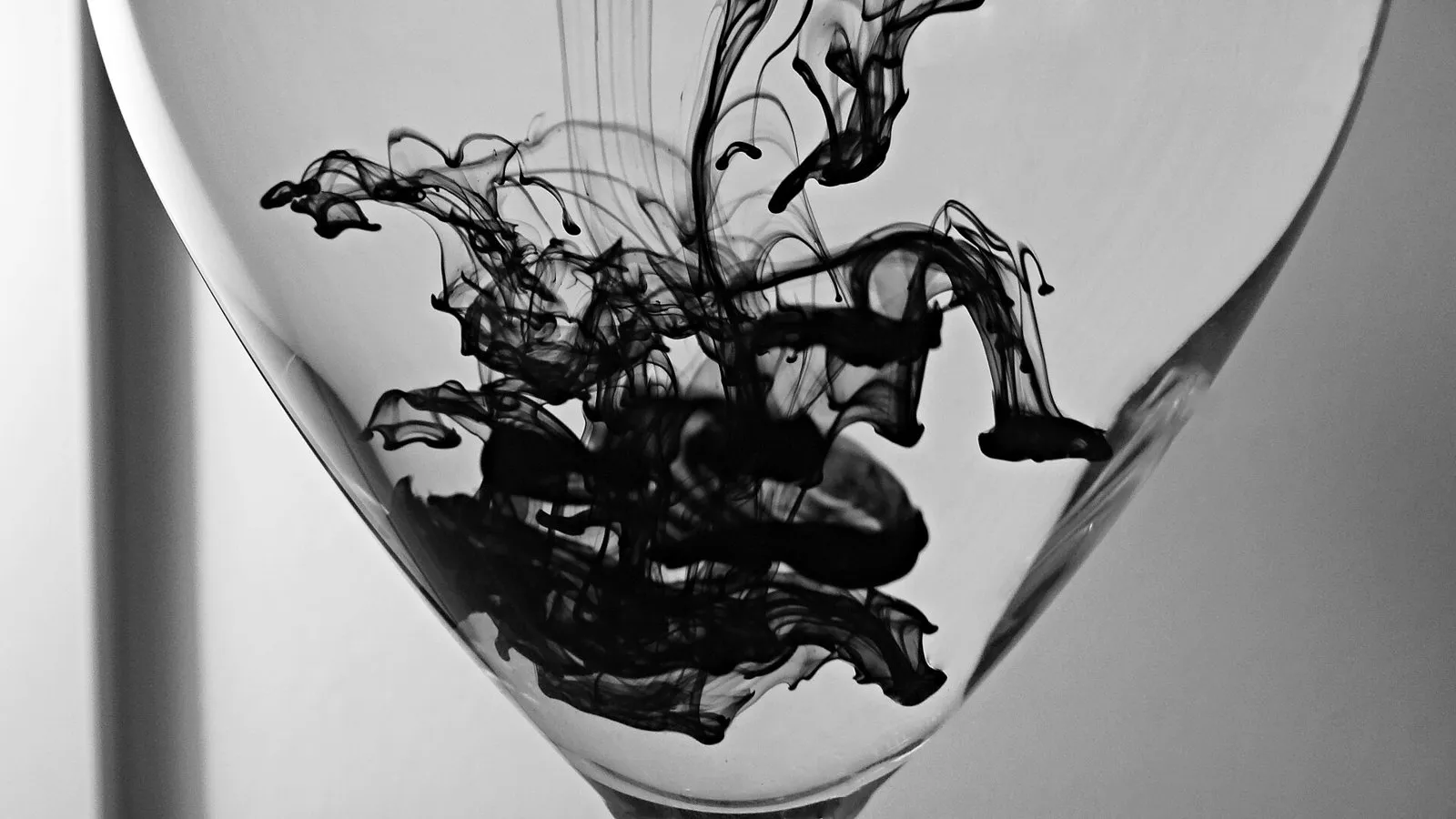
- A drop of food colouring spreads through still water without stirring.
- Sugar dissolved in tea spreads through the cup even if you do not stir it, only more slowly.
2The energy for diffusion
The energy for diffusion comes from the kinetic energy of the random movement of molecules and ions themselves. The cell does not have to supply energy from respiration, so diffusion is a passive process. It carries on in dead cells and in non-living systems too.
See Topic 3 · Movement into and out of cellsCompare this with active transport (3.3), which needs energy from respiration and moves particles against a concentration gradient.3Diffusion into and out of cells
Some substances move into and out of cells by diffusion through the cell membrane. Small molecules such as oxygen, carbon dioxide and water can pass through it easily. A cell that is using oxygen for respiration keeps the oxygen concentration inside low, so oxygen keeps diffusing in; carbon dioxide made by respiration builds up inside and diffuses out.
4Why diffusion is important
| Substance | Where | Direction of diffusion |
|---|---|---|
| Oxygen (gas) | Alveoli in the lungs | From the air in the alveoli into the blood |
| Carbon dioxide (gas) | Alveoli in the lungs | From the blood into the air in the alveoli, then breathed out |
| Carbon dioxide (gas) | Leaves | From the air into the leaf through stomata, for photosynthesis |
| Oxygen and water vapour (gases) | Leaves | Out of the leaf through stomata |
| Glucose and amino acids (solutes) | Small intestine | From the gut into the blood in the villi |
| Oxygen and glucose (solutes in blood) | All body tissues | From the blood into cells for respiration |
| Urea (solute) | Liver and kidneys | From liver cells into the blood, to be removed by the kidneys |
5Factors that affect the rate of diffusion
| Factor | Effect | Why | Example in organisms |
|---|---|---|---|
| Surface area | Larger surface area → faster | More particles can cross at the same time | Millions of alveoli; folded villi in the small intestine |
| Temperature | Higher temperature → faster | Particles have more kinetic energy and move faster | Diffusion is quicker on warm days |
| Concentration gradient | Steeper gradient → faster | A bigger difference means many more particles move one way than the other | Blood flow carries oxygen away from the alveoli, keeping the gradient steep |
| Distance | Shorter distance → faster | Particles have less far to travel | Alveolus and capillary walls are only one cell thick |
Practical: agar cubes and surface area
Practical
Investigating how cube size affects diffusion
Aim. To investigate how surface area (and distance to the centre) affects the rate of diffusion, using agar cubes.
Method
- Use agar that has been made pink with an alkali and phenolphthalein indicator. Cut cubes of side 1 cm, 2 cm and 3 cm.
- Place each cube in a beaker containing the same volume of dilute hydrochloric acid at the same temperature.
- Start a stopwatch. The acid diffuses into the agar and turns it colourless.
- Record the time taken for each cube to become completely colourless (or cut each cube in half after a fixed time and measure the colourless band).
- Repeat with new cubes and calculate the mean time for each size.
| independent variable | Size of the agar cube |
|---|---|
| dependent variable | Time taken for the cube to become colourless |
| controlled variable | Concentration, volume and temperature of the acid; type of agar; whether the beaker is stirred |
Results. The smallest cube turns colourless first. Smaller cubes have a larger surface area compared with their volume, and the acid has a shorter distance to diffuse to reach the centre.
Safety. Wear eye protection. Dilute hydrochloric acid and alkali are irritants; wash off any spills with water.
6Exam focus
Key words that earn the marks
- net movement; higher to lower concentration; down a concentration gradient; random movement.
- Energy: kinetic energy of particles; no energy from respiration.
- Faster with: larger surface area, higher temperature, steeper concentration gradient, shorter distance.
Practice questions
Quick self-check
Answer in your head first, then reveal.
Net movement of particles from a region of higher concentration to a region of lower concentration / down a concentration gradient; as a result of their random movement.
The kinetic energy of the random movement of molecules and ions.
E.g. oxygen from the alveoli into the blood; glucose from the small intestine into the blood.
The diffusion distance is shorter; so oxygen molecules reach the blood more quickly.
At 40 °C; particles have more kinetic energy and move faster, so they diffuse faster.
The small cube has a larger surface area compared with its volume; the acid has a shorter distance to diffuse to reach the centre; so it reaches all of the agar sooner.