Detailed · Deep study
1Solubility rules
To choose a method for making a salt, you need to know whether it is soluble in water.
| Salts | Soluble | Insoluble |
|---|---|---|
| sodium, potassium, ammonium salts | all | – |
| nitrates | all | – |
| chlorides | most | lead(II) chloride, silver chloride |
| sulfates | most | barium sulfate, calcium sulfate, lead(II) sulfate |
| carbonates | sodium, potassium, ammonium carbonates | all others |
| hydroxides | sodium, potassium, ammonium; calcium (partially) | all others |
2Soluble salts from an excess of solid
Use this method when the acid reacts with a metal, an insoluble base (metal oxide or hydroxide) or an insoluble carbonate. The solid is added in excess so that all the acid is used up; the leftover solid is easy to remove by filtration.
- Warm the dilute acid in a beaker.
- Add the solid a little at a time, stirring, until no more dissolves (and, for a carbonate, fizzing stops) – the solid is now in excess.
- Filter to remove the excess solid. The filtrate is a solution of the salt.
- Heat the filtrate in an evaporating basin to concentrate it until it reaches the point of crystallisation (crystals form on a cold glass rod dipped in it).
- Leave to cool so that crystals form. Filter them off, wash with a little cold distilled water and dry between filter papers.
A metal can only be used if it is above hydrogen in the reactivity series and is not too reactive – zinc, magnesium and iron are suitable; sodium and potassium are too dangerous; copper does not react with dilute acids.
3Soluble salts by titration
Sodium, potassium and ammonium salts are made from an acid and an alkali. Both are solutions, so excess cannot be filtered off; instead a titration finds the exact volumes that react.
- Use a pipette to put 25.0 cm³ of alkali into a conical flask and add a few drops of indicator (e.g. methyl orange or thymolphthalein).
- Add acid from a burette, swirling, until the indicator just changes colour (the end-point). Record the volume.
- Repeat without the indicator, using the same volumes, so the salt is not contaminated.
- Evaporate to the point of crystallisation, cool, and collect the crystals as before.
4Insoluble salts by precipitation (Supplement)
An insoluble salt is made by mixing two solutions: one containing its positive ion and one containing its negative ion. The insoluble salt forms as a precipitate.
- Mix solutions of two soluble salts (e.g. barium chloride and sodium sulfate).
- Filter to collect the precipitate.
- Wash it on the filter paper with distilled water to remove soluble impurities.
- Dry it in a warm oven or between filter papers.
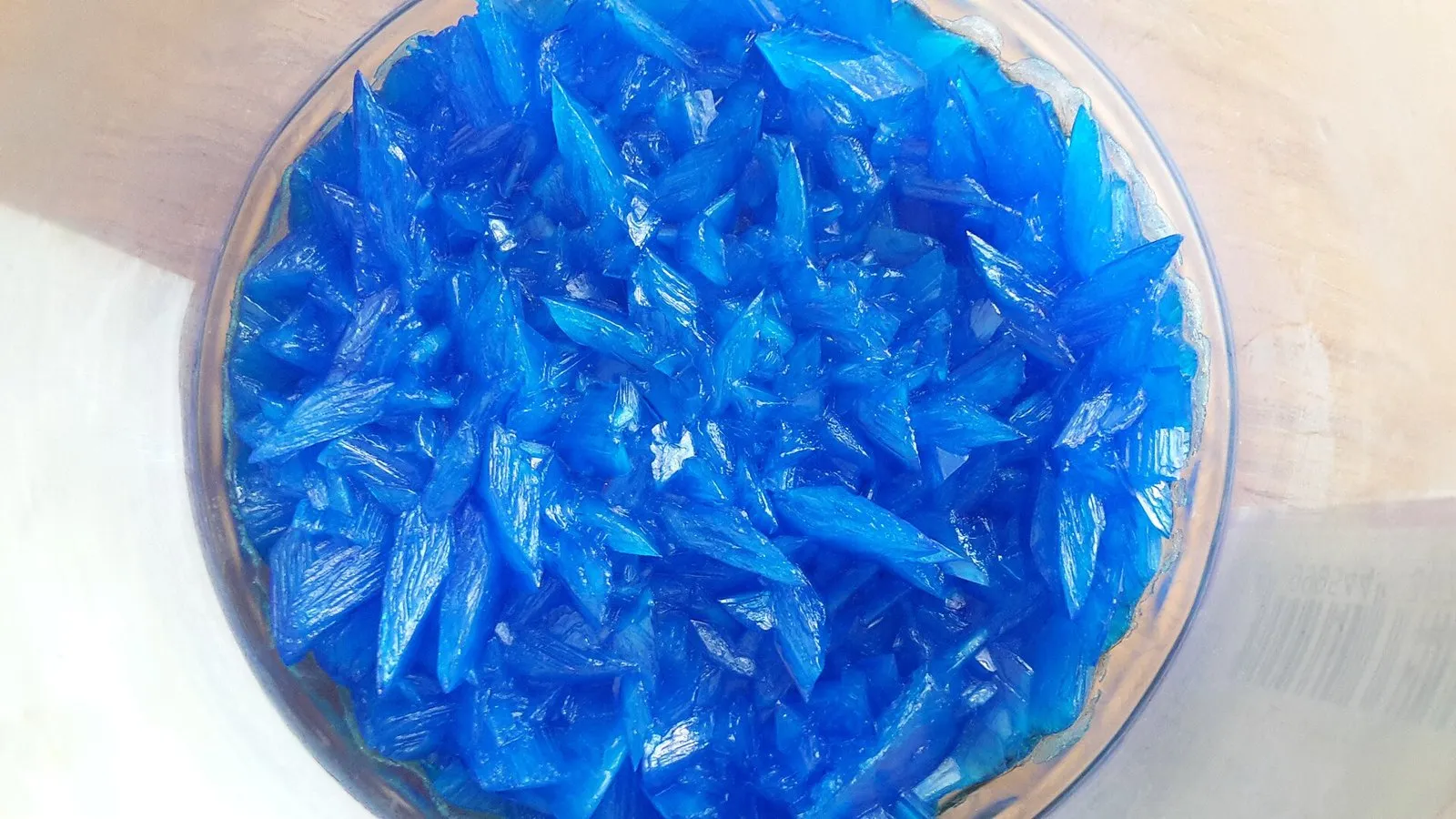
5Hydrated and anhydrous substances
a substance that is chemically combined with water
a substance containing no water
6Exam focus
Key words: excess; filter; filtrate; point of crystallisation; titration; end-point; repeat without indicator; precipitation; wash with distilled water; hydrated; anhydrous; water of crystallisation.
Quick self-check
Answer in your head first, then reveal.
Add excess zinc carbonate to (warm) acid until fizzing stops (1); filter to remove excess (1); heat filtrate to point of crystallisation (1); cool, filter off / dry crystals (1).
To make sure all the acid reacts (1).
Silver chloride (1).
Both reactants (acid and alkali) are soluble, so excess cannot be removed by filtration (1).
Lead(II) nitrate and sodium / potassium sulfate or sulfuric acid (1); filter (1); wash with distilled water (1); dry (1).
Water molecules present in hydrated crystals (1).