Detailed · Deep study
1Redox in terms of oxygen
a reaction involving simultaneous oxidation and reduction
- Oxidation is the gain of oxygen.
- Reduction is the loss of oxygen.
- Whenever one substance gains oxygen, another loses it, so oxidation and reduction always happen together.
Worked example
Identifying oxidation and reduction
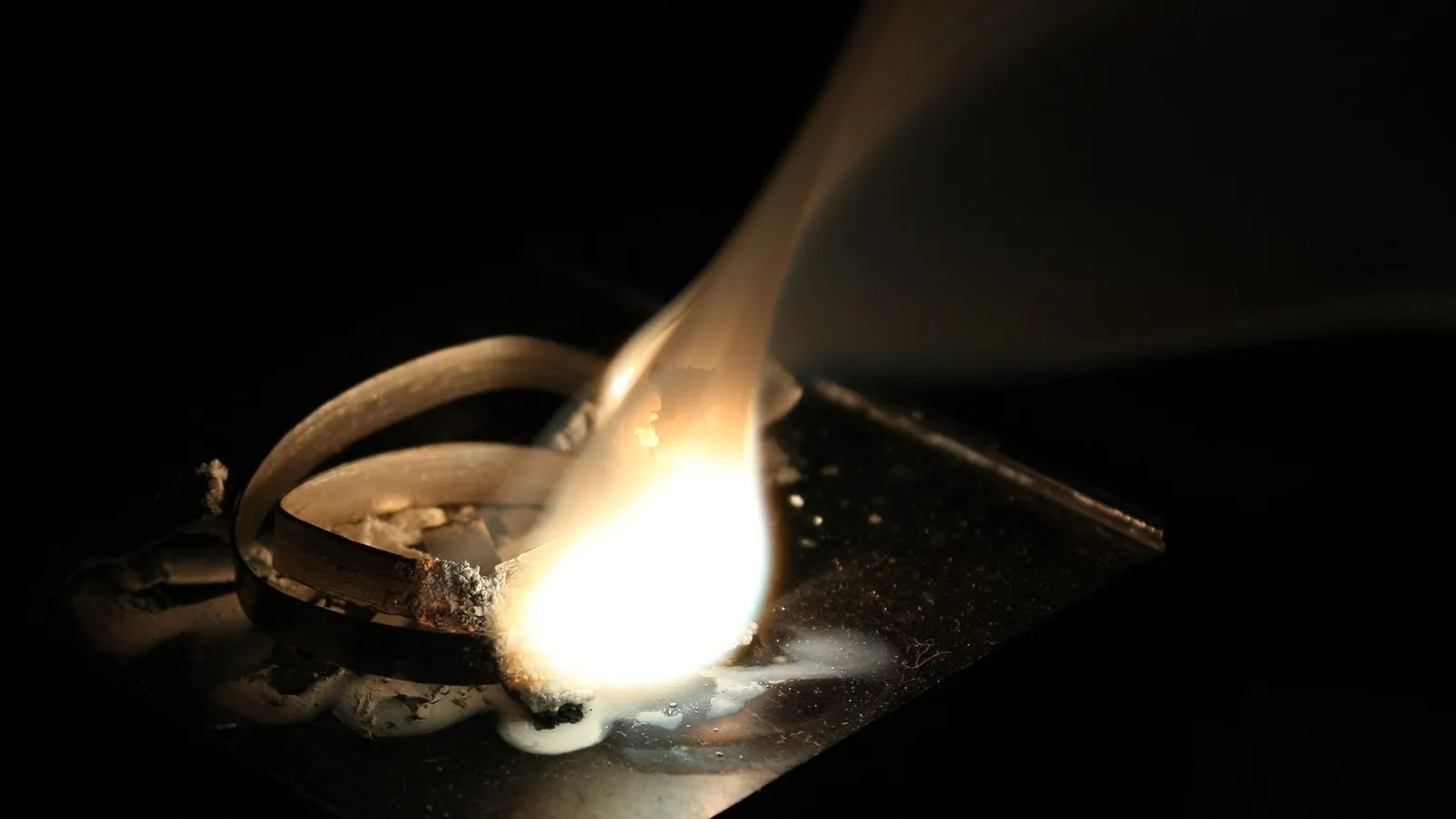
In the thermite reaction , identify the substances oxidised and reduced.
- 1
Which substance loses oxygen?
Fe₂O₃ → Fe: iron(III) oxide is reduced
- 2
Which substance gains oxygen?
Al → Al₂O₃: aluminium is oxidised
AnswerAluminium is oxidised; iron(III) oxide is reduced.
Other examples: combustion (fuel gains oxygen), rusting (iron gains oxygen), extraction of iron in the blast furnace (iron(III) oxide is reduced by carbon monoxide).
2Roman numerals and oxidation numbers
Some metals form ions with different charges. A Roman numeral in the name gives the oxidation number of the element in that compound: iron(II) chloride is (Fe²⁺); iron(III) chloride is (Fe³⁺); copper(II) oxide is CuO; manganese(IV) oxide is .
Rules for oxidation numbers (Supplement)
- The oxidation number of an element in its uncombined state is zero (Fe, O₂, Cl₂).
- For a monatomic ion it equals the charge on the ion (Na⁺ = +1, O²⁻ = −2).
- The sum of oxidation numbers in a compound is zero.
- The sum of oxidation numbers in a compound ion equals the charge on the ion.
- Useful values: O is usually −2; H is usually +1.
Worked example
Working out an oxidation number
Find the oxidation number of manganese in the manganate(VII) ion, .
- 1
Let the oxidation number of Mn be x. Four O at −2 each.
- 2
Solve.
– hence the name manganate(VII)
Answer+7
3Redox in terms of electrons and oxidation number (Supplement)
| Oxidation | Reduction | |
|---|---|---|
| Oxygen (Core) | gain of oxygen | loss of oxygen |
| Electrons (Supplement) | loss of electrons | gain of electrons |
| Oxidation number (Supplement) | increase in oxidation number | decrease in oxidation number |
Worked example
Redox using electrons and oxidation numbers
Zinc is added to copper(II) sulfate solution: . Identify the oxidation and the reduction.
- 1
Zinc: oxidation number 0 → +2; it loses 2 electrons.
: oxidation
- 2
Copper: oxidation number +2 → 0; it gains 2 electrons.
: reduction
AnswerZinc is oxidised; copper(II) ions are reduced.
4Oxidising and reducing agents (Supplement)
a substance that oxidises another substance and is itself reduced
a substance that reduces another substance and is itself oxidised
In , Cu²⁺ is the oxidising agent (it oxidises zinc and is reduced) and zinc is the reducing agent. In , hydrogen is the reducing agent and copper(II) oxide the oxidising agent.
| Reagent | Acts as | Colour change when it reacts | Use |
|---|---|---|---|
| acidified aqueous potassium manganate(VII) | oxidising agent (MnO₄⁻ is reduced) | purple → colourless | tests for a reducing agent |
| aqueous potassium iodide | reducing agent (I⁻ is oxidised to I₂) | colourless → brown (iodine) | tests for an oxidising agent |
5Exam focus
Key words: simultaneous oxidation and reduction; gain / loss of oxygen; loss / gain of electrons; increase / decrease in oxidation number; oxidising agent is itself reduced; reducing agent is itself oxidised; purple to colourless; colourless to brown.
Quick self-check
Answer in your head first, then reveal.
Loss of oxygen (1).
Carbon (1); it gains oxygen (1).
(1).
Loss of electrons (1).
Chlorine / Cl₂ (1); its oxidation number decreases from 0 to −1, so it is reduced (1).
The solution contains a reducing agent (1).