Detailed · Deep study
1Carrying out a titration
A titration finds the exact volume of one solution that reacts with a known volume of another. In an acid–base titration, an acid neutralises an alkali.
- Rinse the volumetric pipette with the alkali, then use a pipette filler to transfer exactly 25.0 cm³ into a clean conical flask.
- Add 2–3 drops of a suitable indicator (methyl orange or thymolphthalein).
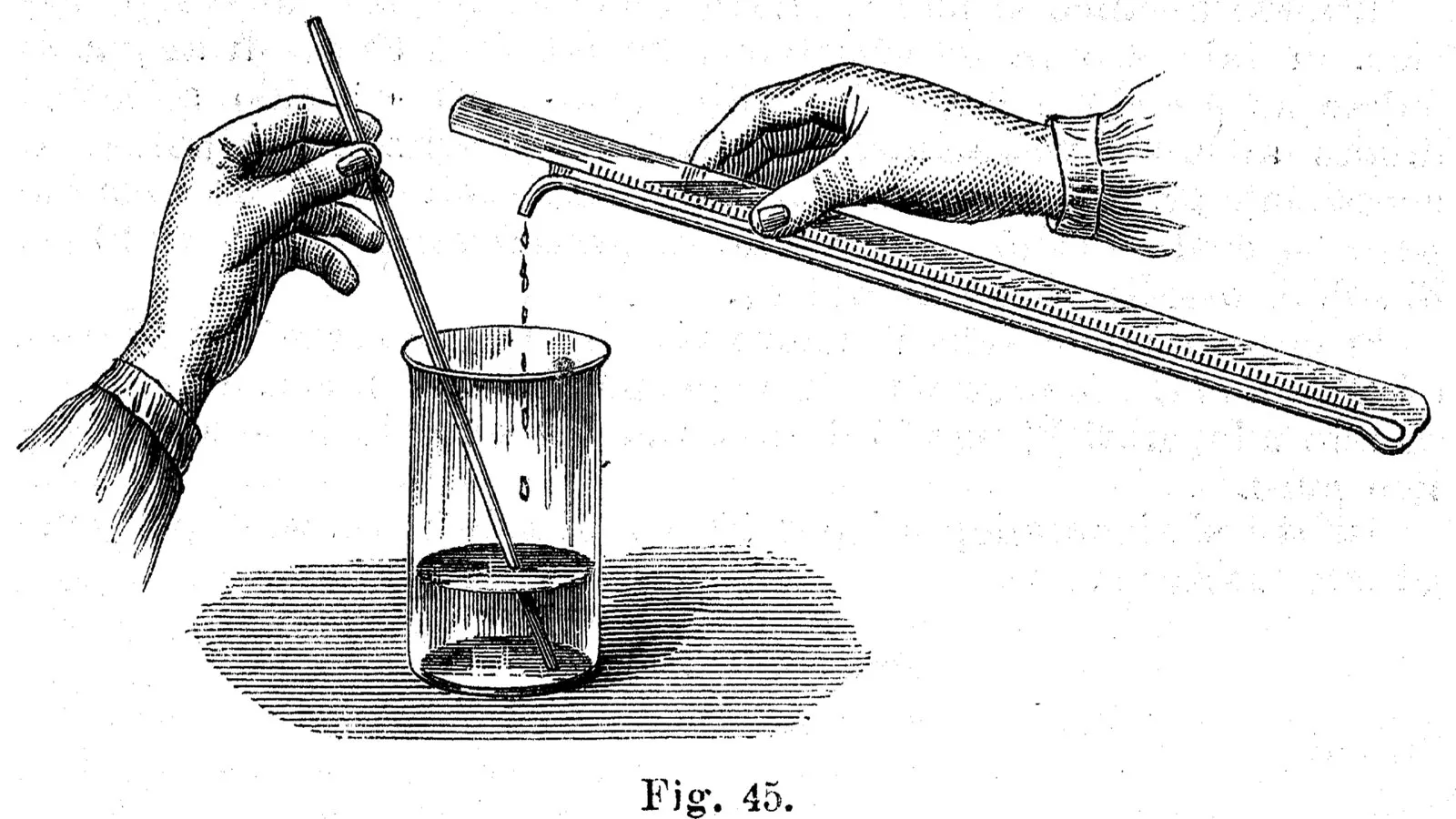
- Rinse the burette with the acid, fill it (with the tap closed) using a funnel, remove the funnel, and run a little out to fill the tip. Record the reading to 0.05 cm³.
- Run the acid into the flask while swirling. Near the end-point add the acid drop by drop.
- Stop at the first permanent colour change. Record the final reading; the titre is final − initial.
- Do a rough titration first, then accurate ones, until two titres are concordant (within 0.10 cm³). Average the concordant titres.
2Identifying the end-point
The end-point is reached when the indicator just changes colour permanently – one drop more of acid would give an excess. A white tile under the flask makes the change easy to see.
| Indicator | Colour in alkali | Colour in acid | End-point (acid added to alkali) |
|---|---|---|---|
| methyl orange | yellow | red | yellow → orange |
| thymolphthalein | blue | colourless | blue → colourless |
| (litmus is not used – its colour change is not sharp) |
3Exam focus
Key words: burette; volumetric pipette; suitable indicator; swirl; drop by drop; end-point – first permanent colour change; white tile; concordant titres.
Quick self-check
Answer in your head first, then reveal.
Burette (1).
Blue (1) to colourless (1).
To see the colour change clearly (1).
23.85 and 23.95 (1); mean 23.90 cm³ (1).