Detailed · Deep study
1Giant covalent structures
In a giant covalent (macromolecular) structure, a huge number of atoms are joined by covalent bonds in a network that continues in all directions. There are no separate molecules. To melt the substance, very many strong covalent bonds must be broken, so giant covalent substances have very high melting and boiling points and are insoluble in water.
Diamond and graphite are two forms of the element carbon. They contain the same atoms but arranged differently, which gives them very different properties.
Diamond
- Each carbon atom is joined by strong covalent bonds to four other carbon atoms, arranged tetrahedrally, in a rigid three-dimensional network.
- Very hard and very high melting point: every atom is locked in place by four strong bonds.
- Does not conduct electricity: all four outer electrons of each carbon are used in bonds, so there are no free electrons.
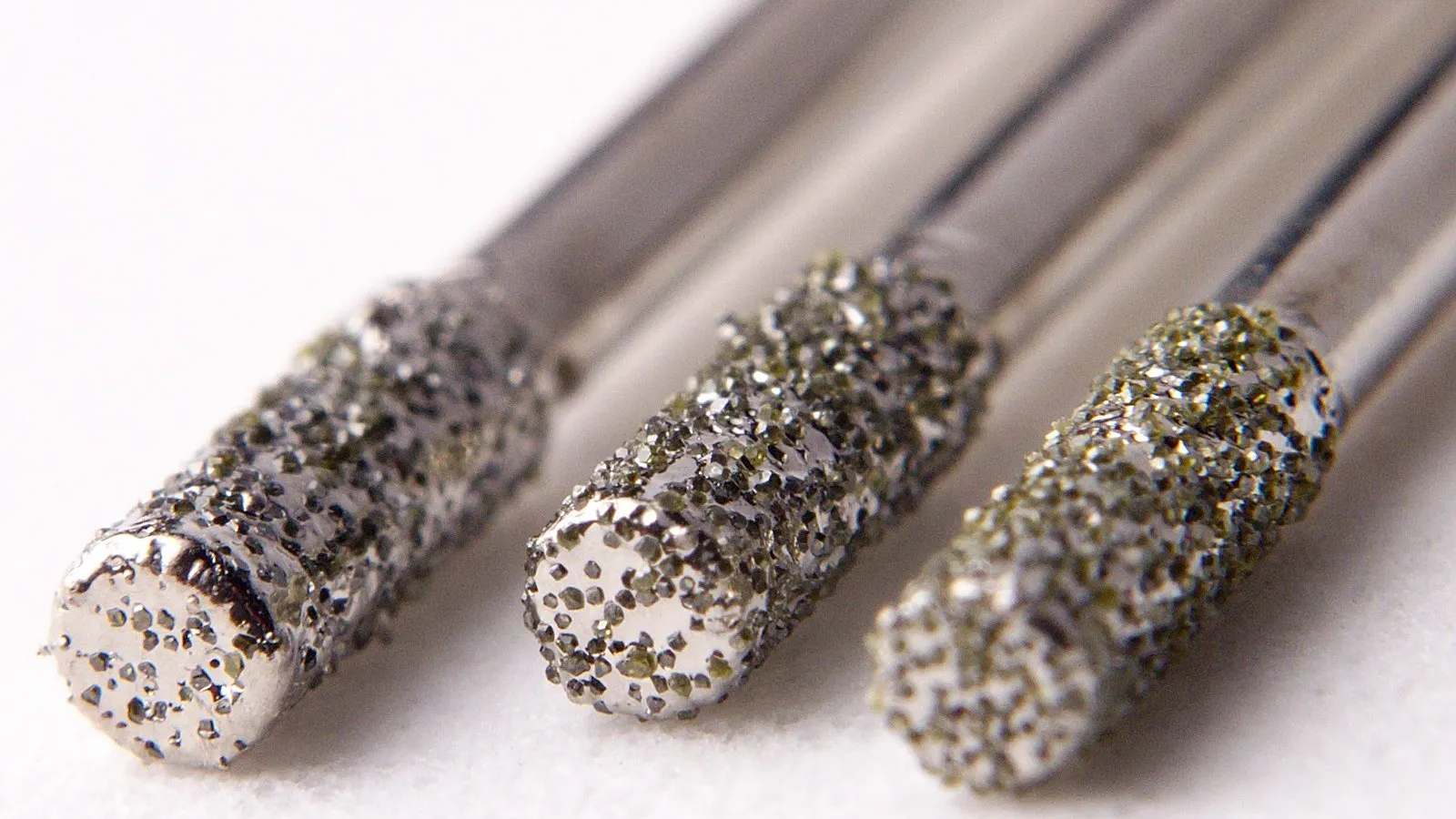
- Use: cutting tools – drill tips and saw blades for cutting stone and glass, because of its hardness.
Graphite
- Each carbon atom is joined to three others, forming flat layers of hexagons.
- The layers are held together by weak forces, so they can slide over each other: graphite is soft and slippery.
- Each carbon has one outer electron not used in bonding. These delocalised electrons can move along the layers, so graphite conducts electricity.
- Uses: as a lubricant (layers slide easily) and as electrodes in electrolysis (it conducts and has a high melting point and is fairly unreactive).
2Silicon(IV) oxide (Supplement)
Silicon(IV) oxide, (silica, found as sand and quartz), is a giant covalent structure. Each silicon atom is bonded to four oxygen atoms arranged tetrahedrally, and each oxygen atom is bonded to two silicon atoms. The ratio of Si to O is therefore 1 : 2.
| Property | Diamond | Silicon(IV) oxide | Reason (both) |
|---|---|---|---|
| Hardness | very hard | very hard | rigid 3-D network of strong covalent bonds |
| Melting point | about 3550 °C | about 1700 °C | many strong covalent bonds must be broken |
| Electrical conductivity | none | none | no free electrons or ions |
| Solubility in water | insoluble | insoluble | bonds too strong to be broken by water |
3Exam focus
Key words: giant covalent; many strong covalent bonds; each C bonded to four (diamond) / three (graphite); layers; weak forces between layers; delocalised electrons; tetrahedral; each Si bonded to four O.
Quick self-check
Answer in your head first, then reveal.
In graphite each carbon is bonded to three others, leaving one delocalised / free electron per atom (1) which can move (1); in diamond all four outer electrons are used in bonds, so there are no free electrons (1).
Layers held by weak forces (1); layers can slide over each other (1).
It is very hard (1); because each carbon is held by four strong covalent bonds in a giant 3-D structure (1).
Giant covalent structure (1); each Si bonded to four O and each O to two Si (1); many strong covalent bonds must be broken, needing a lot of energy (1).