Detailed · Deep study
1Electrolysis and the electrolytic cell
the decomposition of an ionic compound, when molten or in aqueous solution, by the passage of an electric current
Ionic compounds conduct only when molten or dissolved, because then their ions are free to move. A direct current (d.c.) supply is connected to two electrodes dipping into the liquid.
| Part | Meaning |
|---|---|
| anode | the positive electrode (joined to the + terminal) |
| cathode | the negative electrode (joined to the − terminal) |
| electrolyte | the molten or aqueous substance that undergoes electrolysis |
| inert electrode | does not react – platinum or carbon (graphite) |
How charge is transferred (Supplement)
- In the external circuit: electrons flow through the wires from the anode to the positive terminal, and from the negative terminal to the cathode.
- In the electrolyte: current is carried by moving ions – positive ions (cations) move to the cathode and negative ions (anions) move to the anode.
- At the electrodes: cations gain electrons at the cathode; anions lose electrons at the anode. The ions become atoms or molecules (discharged).
2Molten binary compounds
A binary compound contains just two elements. When it is molten, the only ions present are the metal cation and the non-metal anion, so: metal at the cathode, non-metal at the anode.
| Molten compound | Cathode (−) | Anode (+) |
|---|---|---|
| lead(II) bromide, PbBr₂ | lead | bromine |
| sodium chloride, NaCl | sodium | chlorine |
| zinc iodide, ZnI₂ | zinc | iodine |
| aluminium oxide, Al₂O₃ | aluminium | oxygen |
Molten lead(II) bromide: the solid is heated in a crucible until it melts and a bulb lights. Silvery lead collects under the cathode and red-brown bromine vapour is given off at the anode (use a fume cupboard – bromine is toxic).
3Aqueous solutions
Water contains a small number of H⁺ and OH⁻ ions, so an aqueous solution has extra ions that can be discharged.
| Electrolyte (inert electrodes) | Cathode (−): product and observation | Anode (+): product and observation |
|---|---|---|
| molten lead(II) bromide, PbBr₂ | lead – silvery liquid metal collects below the cathode | bromine – red-brown vapour |
| concentrated aqueous sodium chloride | hydrogen – bubbles of colourless gas (squeaky pop with a lit splint) | chlorine – bubbles of pale yellow-green gas (bleaches damp litmus paper) |
| dilute sulfuric acid | hydrogen – bubbles of colourless gas | oxygen – bubbles of colourless gas (relights a glowing splint); half the volume of the hydrogen |
In concentrated sodium chloride solution, H⁺ and Cl⁻ are discharged; the Na⁺ and OH⁻ ions remain, so the solution becomes sodium hydroxide (alkaline). In dilute sulfuric acid, hydrogen and oxygen form in a 2 : 1 volume ratio – effectively water is decomposed.
Predicting products from aqueous halides (Supplement)
- Cathode: hydrogen forms if the metal is more reactive than hydrogen (e.g. Na, K, Ca, Mg); the metal forms if it is less reactive than hydrogen (e.g. copper, silver).
- Anode, concentrated halide solution: the halogen forms (chlorine, bromine or iodine).
- Anode, dilute halide solution: mainly oxygen forms (from OH⁻ ions of water).
| Solution | Cathode | Anode |
|---|---|---|
| concentrated NaCl(aq) | hydrogen | chlorine |
| dilute NaCl(aq) | hydrogen | oxygen |
| concentrated KBr(aq) | hydrogen | bromine (orange solution) |
| CuCl₂(aq), concentrated | copper | chlorine |
Aqueous copper(II) sulfate (Supplement)
| Electrodes | Cathode (−) | Anode (+) | Electrolyte |
|---|---|---|---|
| carbon / graphite (inert) | copper – pink-brown solid coats the electrode | oxygen – bubbles of colourless gas | blue colour fades as Cu²⁺ is removed; solution becomes acidic (sulfuric acid) |
| copper | copper deposited – cathode gains mass | copper dissolves – anode loses mass; no gas | stays blue: Cu²⁺ is replaced as fast as it is removed |
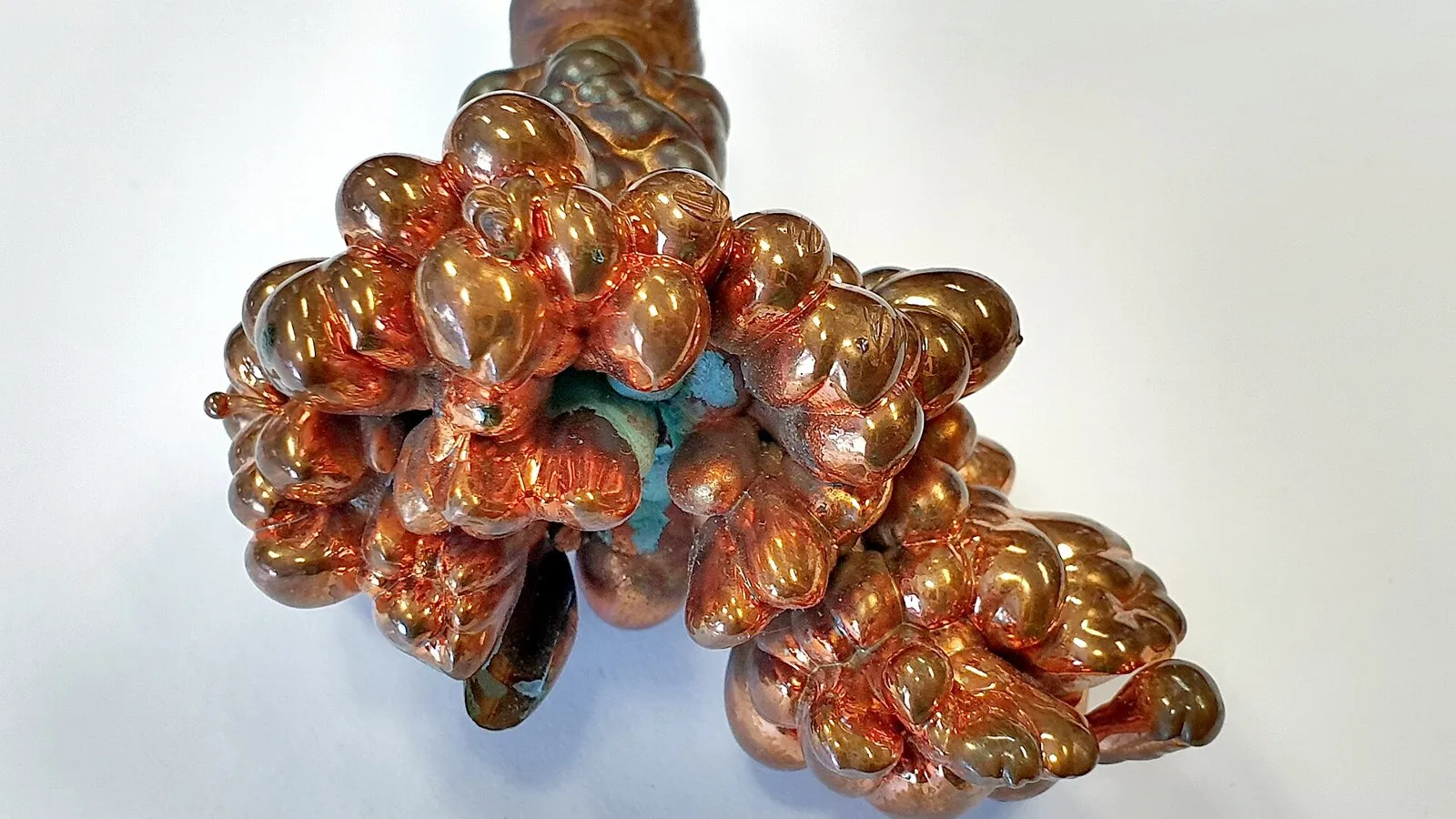
Using copper electrodes in this way is how copper is purified: the impure copper is the anode and a thin sheet of pure copper is the cathode.
4Half-equations (Supplement)
A half-equation shows the change at one electrode, with electrons written as e⁻. At the cathode ions gain electrons – reduction. At the anode ions lose electrons – oxidation.
| Electrode | Half-equation | Process |
|---|---|---|
| cathode | reduction | |
| cathode | reduction | |
| cathode | reduction | |
| anode | oxidation | |
| anode | oxidation | |
| anode | oxidation | |
| anode (copper) | oxidation |
5Electroplating
Metal objects are electroplated to improve their appearance and their resistance to corrosion – for example chromium on steel taps and car parts, silver on cutlery, nickel or tin on steel.
- Clean the object thoroughly and make it the cathode.
- Make the plating metal the anode.
- Use an electrolyte containing ions of the plating metal (e.g. copper(II) sulfate for copper).
- Pass a small direct current: metal ions are reduced and deposit on the object; the anode dissolves to replace them.
6Exam focus
Key words: decomposition; molten or aqueous; anode positive; cathode negative; inert electrodes; metal or hydrogen at the cathode; non-metal at the anode; oxidation at the anode; reduction at the cathode.
Quick self-check
Answer in your head first, then reveal.
Decomposition / breakdown of an ionic compound (1); when molten or aqueous (1); by passing an electric current (1).
cathode: lead (1); anode: bromine (1); red-brown / orange-brown vapour (1).
Damp (blue) litmus paper (1) is bleached (1).
Improve appearance (1); resist corrosion (1).
(1); reduction – electrons gained (1).
Copper anode dissolves / forms Cu²⁺ (1); at the same rate as Cu²⁺ is deposited at the cathode, so concentration stays the same (1).