Detailed · Deep study
1Forming ions
An ion is an atom (or group of atoms) that has an electric charge because it has lost or gained electrons.
- Positive ions (cations) form when atoms – usually metals – lose electrons. Group I atoms lose 1 electron (Na → Na⁺ + e⁻), Group II atoms lose 2, aluminium loses 3.
- Negative ions (anions) form when atoms – non-metals – gain electrons. Group VII atoms gain 1 (Cl + e⁻ → Cl⁻), Group VI atoms gain 2 (O + 2e⁻ → O²⁻).
- In both cases the ion has a full outer shell – the same configuration as a noble gas.
| Group | Electrons lost or gained | Ion charge | Examples |
|---|---|---|---|
| I | lose 1 | +1 | Li⁺, Na⁺, K⁺ |
| II | lose 2 | +2 | Mg²⁺, Ca²⁺ |
| III | lose 3 | +3 | Al³⁺ |
| VI | gain 2 | −2 | O²⁻, S²⁻ |
| VII | gain 1 | −1 | F⁻, Cl⁻, Br⁻ |
2Ionic bonding
a strong electrostatic attraction between oppositely charged ions
When a Group I metal reacts with a Group VII non-metal, each metal atom transfers its one outer electron to a non-metal atom. The positive and negative ions formed attract each other strongly.
Other metals and non-metals (Supplement)
The same idea works for other metals and non-metals. Magnesium (2,8,2) transfers two electrons to oxygen (2,6), forming Mg²⁺ and O²⁻. In calcium chloride, one calcium atom gives one electron to each of two chlorine atoms, so the formula is CaCl₂.
3Structure and properties of ionic compounds
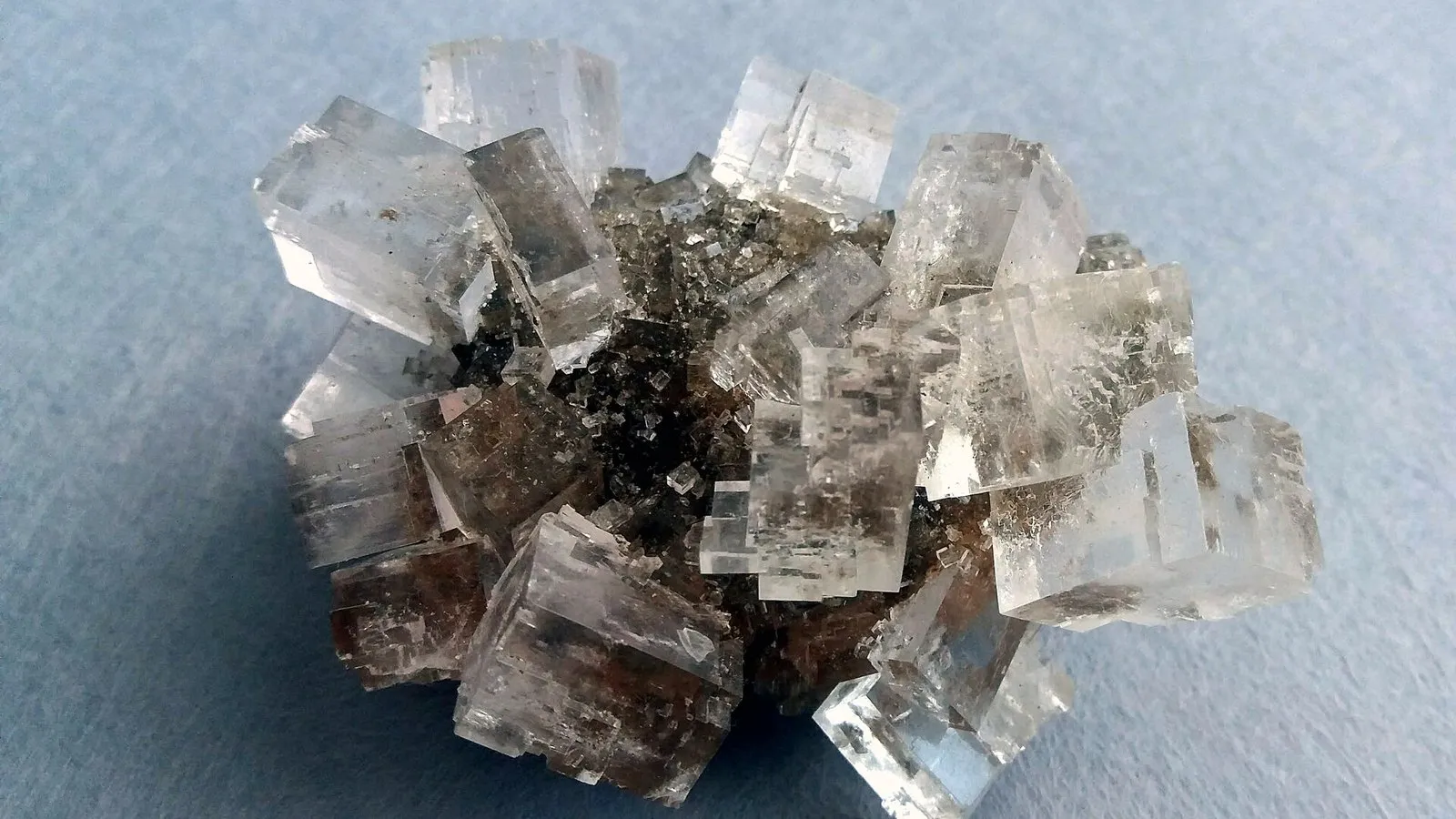
Supplement: ionic compounds form a giant lattice, a regular arrangement of alternating positive and negative ions that continues in all directions. In sodium chloride each Na⁺ is surrounded by six Cl⁻ and each Cl⁻ by six Na⁺.
| Property | Description (Core) | Explanation (Supplement) |
|---|---|---|
| Melting and boiling points | high – sodium chloride melts at 801 °C | many strong electrostatic attractions between oppositely charged ions throughout the giant lattice; a lot of energy is needed to overcome them |
| Electrical conductivity when solid | poor | ions are held in fixed positions and cannot move |
| Electrical conductivity when molten or aqueous | good | the lattice has broken down; the ions are free to move and carry the charge |
4Exam focus
Key words: lose / gain electrons; cation / anion; full outer shell; strong electrostatic attraction between oppositely charged ions; giant lattice; ions free to move (molten or aqueous); ions fixed (solid).
Quick self-check
Answer in your head first, then reveal.
It loses (1); one electron (from its outer shell) (1) – forming Na⁺ / a positive ion.
K⁺ in brackets with an empty / no outer shell drawn or 8 electrons of the inner shell (1); Cl⁻ with 8 outer electrons, one shown as a different symbol (1); correct charges (1).
(Giant lattice with) strong electrostatic attraction between oppositely charged ions (1); many / lots of energy needed to overcome them (1).
In the solid the ions are fixed in place (1); when molten the ions are free to move and carry charge (1).
Calcium atom loses two electrons forming Ca²⁺ (1); each of two chlorine atoms gains one electron forming Cl⁻ (1); oppositely charged ions attract / ionic bond, formula CaCl₂ (1).