Detailed · Deep study
1Diffusion and the kinetic particle theory
The net movement of particles from a region of higher concentration to a region of lower concentration as a result of their random motion.
In a gas or a liquid the particles move all the time in random directions. Where there are more particles of a substance, more of them happen to move away than move back in, so overall (the net movement) they spread from high to low concentration. Nothing has to push or stir them.
Diffusion continues until the particles are evenly spread. The particles still move after this, but there is no longer any net movement in one direction.
Everyday and laboratory examples
- A smell (food, perfume, a gas leak) spreads through a still room.
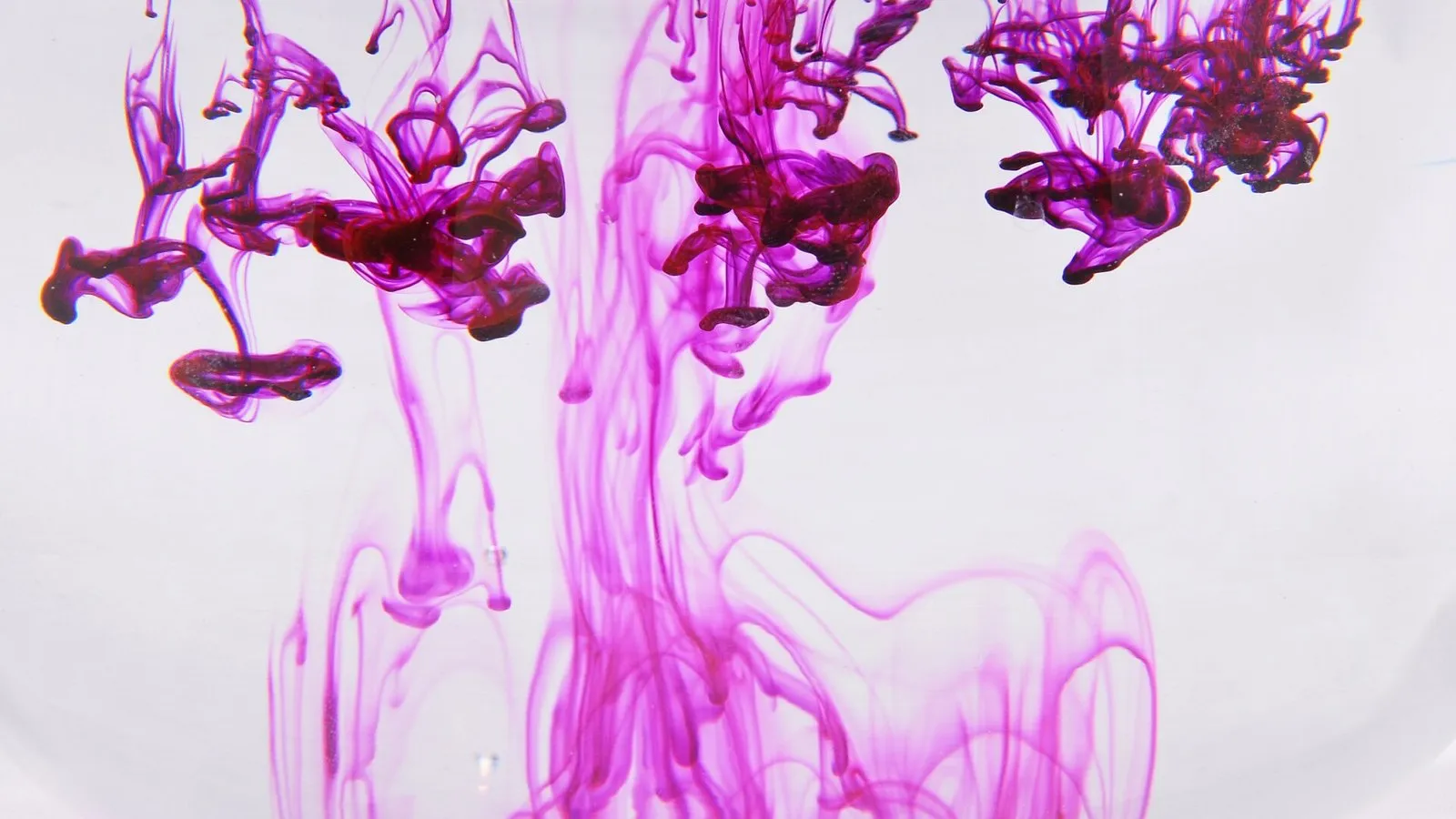
- A crystal of potassium manganate(VII) dropped into water slowly turns all the water purple without stirring.
- Brown bromine vapour spreads up into a gas jar of air placed on top of it.
How fast is diffusion?
| State | Diffusion | Why |
|---|---|---|
| Gas | fast – minutes | particles move quickly and are far apart, so they travel far between collisions |
| Liquid | slow – hours or days | particles move more slowly and keep colliding with neighbours |
| Solid | does not happen | particles only vibrate about fixed positions |
Raising the temperature speeds up diffusion, because the particles gain kinetic energy and move faster.
2Relative molecular mass and the rate of diffusion (Supplement)
At the same temperature, particles of all gases have the same average kinetic energy. Lighter particles (lower relative molecular mass, ) therefore move faster than heavier ones, so gases with a lower diffuse faster.
See Topic 3 · Chemical BondingRelative molecular mass, , is worked out by adding up relative atomic masses (3.2).The ammonia and hydrogen chloride experiment
- Cotton wool soaked in concentrated ammonia solution is put in one end of a long, dry glass tube and cotton wool soaked in concentrated hydrochloric acid in the other end, at the same time.
- Ammonia gas and hydrogen chloride gas diffuse along the tube towards each other.
- Where they meet they react: ammonia + hydrogen chloride → ammonium chloride, a white solid.
- The white ring forms closer to the hydrochloric acid end, because ammonia ( = 17) diffuses faster than hydrogen chloride ( = 36.5) and travels further in the same time.
3Exam focus
Key words that earn marks: random movement; particles; net movement; from higher to lower concentration; faster in gases than liquids; higher temperature → faster particles; lower → faster diffusion.
Quick self-check
Answer in your head first, then reveal.
The crystal dissolves and its particles move randomly (1); they spread from where the concentration is high to where it is low / by diffusion (1); until they are evenly spread through the water (1).
Particles in a solid only vibrate about fixed positions (1); they cannot move from place to place, so cannot mix (1).
Raise the temperature (1); the particles gain kinetic energy and move faster (1).
Ammonia has a lower relative molecular mass (17) than hydrogen chloride (36.5) (1); so its particles move faster / ammonia diffuses faster (1); so it travels further before the gases meet (1).
Nitrogen (1); lower relative molecular mass, so its particles move faster (1).