Detailed · Deep study
1Two transport tissues
Plants have two transport tissues, which run together in vascular bundles from the roots, through the stem, into every leaf.
| Tissue | Carries | Direction | Other function |
|---|---|---|---|
| Xylem | Water and mineral ions | Upwards, from roots to leaves | Support: its thick walls help hold the plant up |
| Phloem | Sucrose and amino acids | Up or down, from where they are made or stored to where they are needed | — |
2Where xylem and phloem are found
| Organ | Position |
|---|---|
| Root | Xylem in the centre, often shaped like a star or cross; phloem in groups between the arms of the xylem |
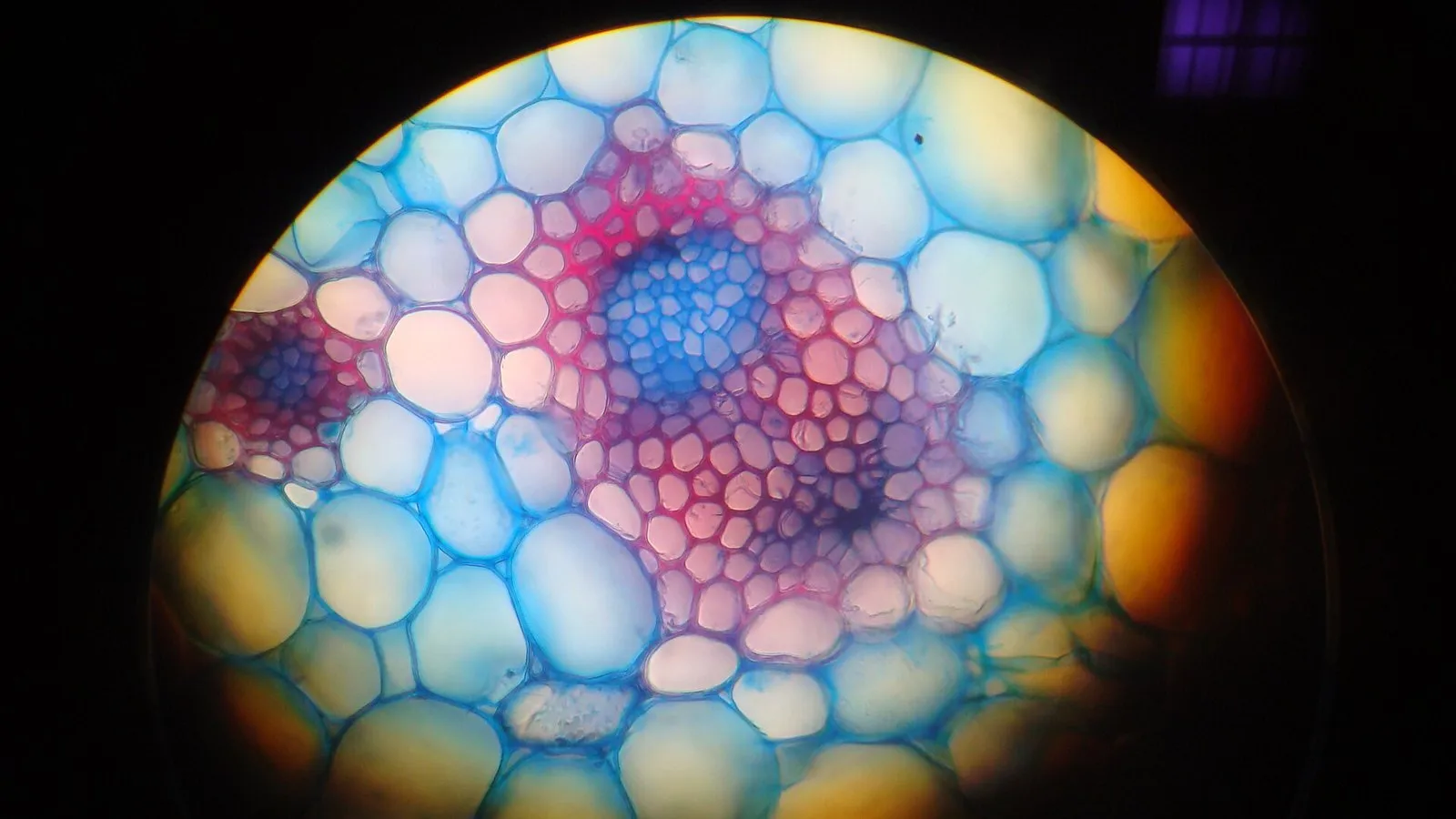
| Stem | Vascular bundles in a ring near the outside; in each bundle xylem is on the inside, phloem on the outside |
| Leaf | In the veins (vascular bundles); in each, xylem is on the upper side, phloem on the lower side |
Practical
Seeing xylem in a stem
Aim. To identify the position of xylem in a stem.
Method
- Stand a stalk of celery in water containing a coloured dye for a few hours.
- Cut thin cross-sections and look at them with a hand lens or microscope.
Results. The dye shows up as coloured dots in a ring near the outside: the xylem in the vascular bundles.
Safety. Take care when cutting with a scalpel.
3Structure of xylem vessels (Supplement)
| Structure | How it suits the function |
|---|---|
| Thick walls with lignin | Strong, so the vessels support the plant and do not collapse as water is pulled up |
| No cell contents | The vessel is hollow, so nothing gets in the way of the flow of water and mineral ions |
| Cells joined end to end with no cross walls | Form a long continuous tube from the roots to the leaves |
4Exam focus
Practice questions
Quick self-check
Answer in your head first, then reveal.
Transport of water and mineral ions; support.
Sucrose; amino acids.
In vascular bundles arranged in a ring; xylem on the inside and phloem on the outside of each bundle.
Thick walls with lignin give support / prevent collapse; no cell contents so water flows freely; no cross walls so they form a continuous tube.