Detailed · Deep study
1Animal and plant kingdoms
A kingdom is the largest group that organisms are classified into. All organisms have some features in common, such as cytoplasm, a cell membrane and DNA. The features below are the ones used to decide whether an organism belongs in the animal kingdom or the plant kingdom.
| Feature | Animals | Plants |
|---|---|---|
| Number of cells | Many (multicellular) | Many (multicellular) |
| Cell wall | None | Present, made of cellulose |
| Chloroplasts | None | Present in many cells, e.g. in leaves |
| How they get food | Eat other organisms or their products and digest them inside the body | Make their own food by photosynthesis |
| Movement | Usually move the whole body from place to place | Usually fixed in one place |
| Examples | Insects, fish, humans | Grasses, ferns, mango trees |
2Vertebrates
Vertebrates are animals with a backbone (vertebral column) made of small bones called vertebrae. They also have a skull that protects the brain. There are five main classes.
Features of the five classes
| Class | Body covering | Breathing | Reproduction | Other key features | Examples |
|---|---|---|---|---|---|
| Mammals | Fur or hair | Lungs | Internal fertilisation; most give birth to live young; young fed on milk from mammary glands | External ear flaps (pinnae); whiskers; different types of teeth; constant body temperature | Human, lion, bat, whale |
| Birds | Feathers; scales on legs | Lungs | Internal fertilisation; eggs with hard shells | Beak with no teeth; front limbs are wings; constant body temperature | Chicken, ostrich, eagle |
| Reptiles | Dry, scaly skin | Lungs | Internal fertilisation; eggs with rubbery or leathery shells, laid on land | Body temperature varies with surroundings | Crocodile, chameleon, snake, tortoise |
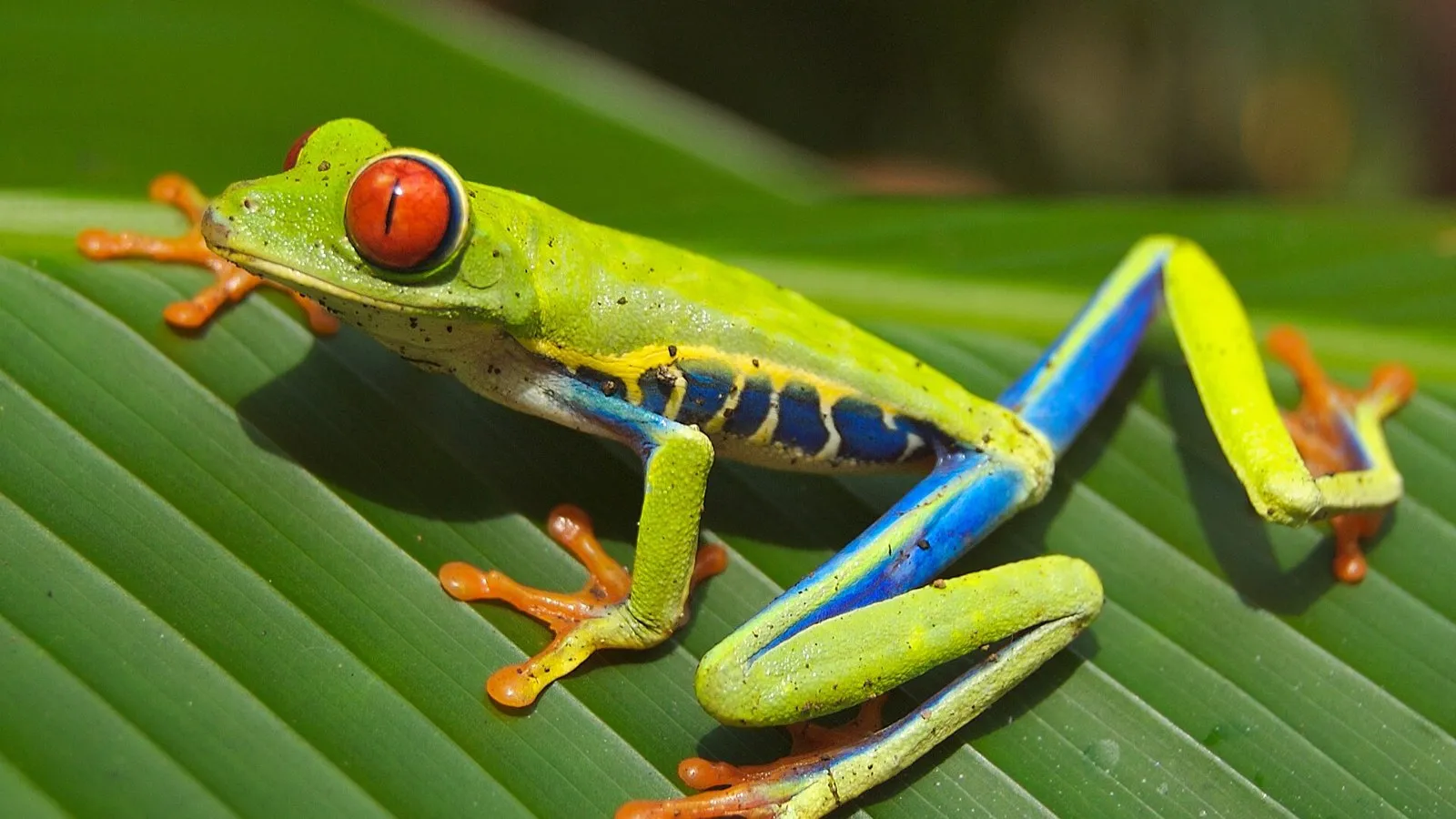
| Amphibians | Moist, smooth skin; no scales | Larvae (tadpoles) use gills; adults use lungs and skin | Usually external fertilisation; eggs without shells, laid in water | Live partly in water and partly on land; body temperature varies | Frog, toad |
| Fish | Wet scales | Gills | Usually external fertilisation; eggs without shells, laid in water | Fins; streamlined body; body temperature varies | Tilapia, Nile perch, shark |
Scales, skin and eggs: telling the classes apart
- Scales: fish have wet scales; reptiles have dry scales; amphibians have none.
- Eggs: birds lay hard-shelled eggs; reptiles lay rubbery- or leathery-shelled eggs; fish and amphibians lay eggs with no shell, in water.
- Body temperature: birds and mammals keep a constant body temperature; fish, amphibians and reptiles do not, so their temperature changes with their surroundings.
3Arthropods
Arthropods are invertebrates (animals with no backbone). The name means 'jointed legs'. They make up the largest group of animals on Earth.
- A hard exoskeleton (outer skeleton) that supports and protects the body.
- Jointed legs.
- A segmented body, often grouped into regions.
The four groups
| Group | Body parts | Legs | Antennae | Other features | Examples |
|---|---|---|---|---|---|
| Insects | 3: head, thorax, abdomen | 3 pairs | 1 pair | Usually 2 pairs of wings (flies have 1 pair); compound eyes | Housefly, mosquito, honeybee, black soldier fly |
| Arachnids | 2: cephalothorax, abdomen | 4 pairs | None | Several simple eyes; no wings | Spider, scorpion, tick, mite |
| Crustaceans | Often 2: cephalothorax, abdomen | More than 4 pairs | 2 pairs | Exoskeleton hardened with calcium salts (chalky); mostly live in water | Crab, prawn, lobster, woodlouse |
| Myriapods | Head plus many similar segments | On every segment | 1 pair | No wings; centipedes have 1 pair of legs per segment, millipedes 2 pairs | Millipede, centipede |
4Classifying organisms from their features
To classify an organism, first decide its kingdom, then use features you can see to place it in a group. A key makes this systematic.
| Organism and features seen | Kingdom | Group |
|---|---|---|
| Chameleon: dry scaly skin, four legs, lays eggs on land | Animal | Vertebrate: reptile |
| Bat: fur, wings made of skin, feeds young on milk | Animal | Vertebrate: mammal |
| Tick: 4 pairs of legs, no antennae, 2 body parts | Animal | Arthropod: arachnid |
| Woodlouse: many legs, 2 pairs of antennae, hard exoskeleton | Animal | Arthropod: crustacean |
| Black soldier fly: 3 pairs of legs, 1 pair of wings, 1 pair of antennae | Animal | Arthropod: insect |
5The five kingdoms (Supplement)
| Kingdom | Cells | Nucleus | Cell wall | Nutrition | Examples |
|---|---|---|---|---|---|
| Animal | Many | Yes | None | Feed on other organisms | Insects, mammals |
| Plant | Many | Yes | Cellulose | Photosynthesis (chloroplasts) | Ferns, flowering plants |
| Fungus | Usually many, as thread-like hyphae; yeast is single-celled | Yes | Present, not cellulose | No chloroplasts; digest dead or living material outside their cells and absorb the products | Mushrooms, bread mould, yeast |
| Prokaryote | Single cell | No (DNA is a circular loop in the cytoplasm, plus plasmids) | Present, not cellulose | Varies; some photosynthesise | Bacteria |
| Protoctist | Mostly single cells; some many | Yes | Some have one | Some have chloroplasts (plant-like); others take in food (animal-like) | Amoeba, Plasmodium, Chlamydomonas, seaweeds |
6Ferns and flowering plants (Supplement)
Ferns
- Have roots, stems and leaves; the leaves are called fronds and are usually divided into leaflets.
- Young fronds are tightly coiled and unroll as they grow.
- The stem is often underground.
- Have no flowers and make no seeds.
- Reproduce by spores, made in sporangia that form brown clusters on the underside of the fronds.
Flowering plants
Flowering plants reproduce using flowers and make seeds that develop inside a fruit (from the ovary). They are split into two groups by the number of cotyledons (seed leaves) in the seed.
| Feature | Monocotyledons | Dicotyledons |
|---|---|---|
| Cotyledons in the seed | One | Two |
| Leaf shape | Usually long and narrow | Usually broad |
| Leaf veins | Parallel | Branching (network) |
| Flower parts | In threes or multiples of three | In fours or fives |
| Examples | Maize, rice, grasses, lilies, bananas | Beans, mango, sunflower, roses |
7Viruses (Supplement)
- A virus is made of genetic material (DNA or RNA) inside a protein coat.
- It has no cell membrane, cytoplasm, nucleus or ribosomes, so it is not a cell.
- It can only reproduce inside a living host cell, using the cell's materials.
- Viruses are not placed in any of the five kingdoms. Examples include HIV, influenza and the measles virus.
8Exam focus
Key words that earn the marks
| Group | Features to quote |
|---|---|
| Plant vs animal | cellulose cell wall, chloroplasts, photosynthesis |
| Mammal | fur/hair, mammary glands/milk, external ear (pinna) |
| Bird | feathers, beak, wings, hard-shelled eggs |
| Reptile | dry scales, eggs with rubbery shells |
| Amphibian | moist skin, no scales, eggs laid in water |
| Fish | wet scales, fins, gills |
| Insect / arachnid | 3 vs 4 pairs of legs; 1 pair vs no antennae; 3 vs 2 body parts |
| Crustacean / myriapod | 2 pairs of antennae / legs on every segment |
| Virus (Supplement) | protein coat, genetic material |
Practice questions
Quick self-check
Answer in your head first, then reveal.
Cellulose cell wall; chloroplasts.
Crocodile: dry scaly skin and shelled eggs laid on land (reptile); frog: moist skin with no scales and eggs without shells laid in water (amphibian).
Crustacean.
It has four pairs of legs (insects have three); it has no antennae / two body parts (insects have one pair of antennae / three body parts).
No nucleus (circular DNA free in the cytoplasm).
Fern; the patches are clusters of sporangia that release spores.
A protein coat; genetic material (DNA or RNA).