Detailed · Deep study
1Leaf shape: large surface area and thin
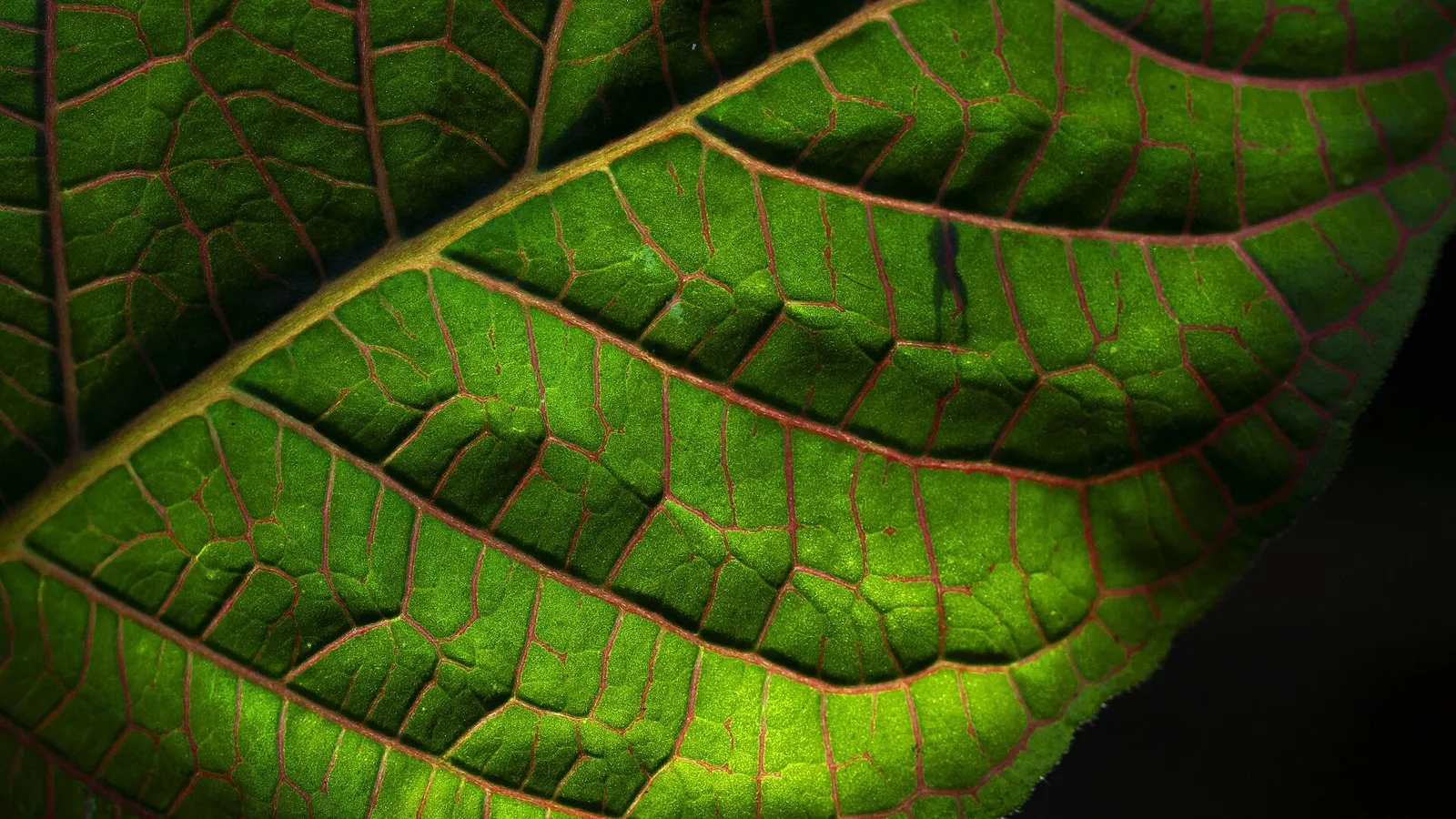
Most leaves have a large surface area and are thin. Both features help photosynthesis.
| Feature | Why it helps |
|---|---|
| Large surface area | Absorbs as much light as possible; provides room for many stomata so more carbon dioxide can diffuse in |
| Thin | Carbon dioxide has only a short distance to diffuse from the air to the mesophyll cells; light can reach the cells all the way through |
2Structures inside a dicotyledonous leaf
| Structure | Description | Adaptation for photosynthesis |
|---|---|---|
| Cuticle | Thin waxy layer on the outer surface | Waterproof, so reduces water loss; transparent, so light passes through |
| Upper epidermis | Single layer of cells with no chloroplasts | Transparent, letting light through to the mesophyll; protects the leaf |
| Palisade mesophyll | Tall, column-shaped cells packed closely together near the upper surface | Contain many chloroplasts; their position near the top means they receive the most light; most photosynthesis happens here |
| Chloroplasts | Contain chlorophyll | Absorb light energy for photosynthesis; they can move within cells towards the light |
| Spongy mesophyll | Loosely packed, rounded cells with fewer chloroplasts | Large surface area of moist cell walls for gas exchange |
| Air spaces | Gaps between spongy mesophyll cells, linked to the stomata | Allow carbon dioxide to diffuse quickly to all the mesophyll cells and oxygen to diffuse out |
| Stomata | Pores, mostly in the lower epidermis | Let carbon dioxide in and oxygen and water vapour out |
| Guard cells | Pair of curved cells around each stoma; contain chloroplasts | Open and close the stoma, controlling gas exchange and water loss |
| Lower epidermis | Layer of cells on the underside | Contains most of the stomata; being on the shaded side reduces water loss |
| Vascular bundle | A vein, containing xylem and phloem | Supplies the leaf and supports it |
| Xylem | Wide tubes with thick walls, in the vascular bundle | Brings water (a raw material) and mineral ions to the leaf |
| Phloem | Smaller tubes, in the vascular bundle | Carries sucrose and amino acids away from the leaf to the rest of the plant |
3Following the raw materials
- Light passes through the transparent cuticle and upper epidermis and is absorbed by chloroplasts, mostly in the palisade mesophyll.
- Carbon dioxide diffuses in through the stomata, through the air spaces, and into the mesophyll cells.
- Water arrives in the xylem of the vascular bundles and moves into the mesophyll cells.
- Glucose made in the mesophyll is converted to sucrose and carried away in the phloem.
- Oxygen diffuses out through the air spaces and stomata.
Practical
Looking at stomata
Aim. To observe stomata and guard cells in the lower epidermis of a leaf.
Method
- Paint a small patch of clear nail varnish on the lower surface of a leaf and let it dry.
- Press clear sticky tape onto the varnish, peel it off and stick it onto a microscope slide.
- Observe at low then high power. Count the stomata in the field of view.
- Repeat with the upper surface and compare.
Results. Many more stomata are usually seen on the lower surface. Each stoma is a pore between two curved guard cells.
Safety. Use nail varnish in a ventilated room, away from flames.
4Exam focus
Key points that earn the marks
- Link each structure to a reason: 'many chloroplasts to absorb light'; 'air spaces so carbon dioxide can diffuse'.
- Thin leaf: short diffusion distance. Large surface area: absorbs more light.
- Palisade = most chloroplasts; spongy = air spaces; xylem = water in; phloem = sucrose out; stomata = CO₂ in.
Practice questions
Quick self-check
Answer in your head first, then reveal.
Large surface area; thin; e.g. large surface area absorbs more light / thin gives a short diffusion distance for carbon dioxide.
The cells contain many chloroplasts; they are near the upper surface so receive the most light.
Diffuses in through a stoma; through the air spaces in the spongy mesophyll; into the palisade cell.
Xylem brings water and mineral ions to the leaf; phloem carries sucrose (and amino acids) away.
It is transparent / has no chloroplasts, so light passes through to the mesophyll.